|
Editorial
|
Press Releases
|
Book Reviews
|
Fragments
Artifacts: The Exodus Revelation I
The Journey: Ireland I
|
Giants of Ireland
|
The Lord of the Rings Cipher I
Register
for our Hall of Records Newsletter
Questions? Comments? Suggestions? Advertising? Press Releases?
Contact us!
Introduction
|
J.R.R. Tolkien
|
The Song of Creation
|
The Shaping of Earth
Two Lamps, Two Trees, Two Witnesses
|
The War of the Jewels
|
Morgoth's Ring
LOTR_Cipher Notes
|
LOTR_Cipher Links
|
LOTR_Cipher Books
|
LOTR_Cipher Audio
LOTR_Cipher Video
|
LOTR_Cipher Collectibles

|
There was Eru, the One, who in Arda is called Ilúvatar;
and he made first the Ainur, the Holy Ones, who were the offspring of his thought,
and they were with him before aught else was made.
And he spoke to them, propounding to them themes of music;
and they sang before him, and he was glad.
But for a long while they sang only each alone, or but few together,
while the rest hearkened;
for each only comprehended that part of the mind of Ilúvatar from which he came,
and in the understanding of their brethren they grew but slowly.
Yet ever as they listened they came to deeper understanding,
and increased in unison and harmony.
And it came to pass that Ilúvatar called together all the Ainur,
and declared to them a mighty theme,
unfolding to them things greater and more wonderful than he had yet revealed;
and the glory of its beginning and the splendour of its end amazed the Ainur,
so that they bowed before Ilúvatar and were silent.
Then Ilúvatar said to them:
"Of the theme that I have declared to you,
I will now that ye make in harmony together a Great Music.
And since I have kindled you with the Flame Imperishable,
ye shall show forth your powers in adorning this theme,
each with his own thoughts and devices,
if he will.
But I will sit and hearken,
and be glad that through you great beauty
has been wakened into song."
Then the voices of the Ainur,
like unto harps and lutes, and pipes and trumpets, and viols and organs,
and like unto countless choirs singing with words,
began to fashion the theme of Ilúvatar to a great music;
and a sound arose of endless interchanging melodies woven in harmony
that passed beyond hearing into the depths and into the heights
and the places of the dwelling of Ilúvatar were filled to overflowing,
and the music and the echo of the music went out into the Void,
and it was not void.13
Thus begins the
Ainulindalë,
the great
cosmogonic
story of The Lord of the Rings. Naturally situated at the beginning of The Silmarillion, the Ainulindalë (lit., "The Song of the Ainur") describes not only how the world of Middle Earth was created, but also how the entire universe was created — out of music that filled an otherwise empty void that was larger than the universe, darker than space, and older than time. And it goes even further to describe how the universe is a subset of an even higher realm of reality (possibly the only true reality) wherein dwell divine beings of enormous power. And over all these beings there exists a High God, named
Eru
(lit., "the One"), also known as Ilúvatar ("Father of All").

|
|
|
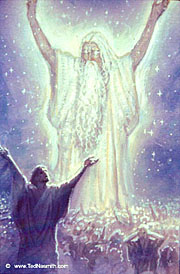
Ilúvatar,
the "God" of Middle Earth, leading the heavenly chorus of angelic
Ainur
in the
Ainulindalë,
the song of creation from which the universe of Arda was born, as described in Tolkien's seminal, posthumously published masterpiece The Silmarillion. The first and most powerful of the Ainur that Ilúvatar created was a spirit known as
Melkor.
Melkor, later known as
Morgoth,
was the greatest of the Ainur, but fell from glory when he disrupted the Music of the Ainur and defied the will of Ilúvatar. While all the Ainur were singing the universe into existence, Melkor began to weave his own ideas into the song of creation, ideas that clashed with the Theme of Ilúvatar and disturbed the
Ainur
around him, causing some of them to attune their music to his instead. This was the first rebellion against Ilúvatar, making Melkor the
Satan
figure in the world of Middle Earth. Tolkien's belief, apparently, was that our universe was created through the medium of song, as it was the Ainulindalë that was the medium through which Ilúvatar created the universe of Arda.
Cosmogonies,
or "creation stories", including the Hebrew cosmogony, were typically sung, not spoken. Tolkien no doubt backwards extrapolated this fact into the concept that the universe of Arda, or "Middle Earth" must also have been "sung" into existence. Thus by extension, our own universe must have been sung into existence as well.
Image from
Tolkien Gateway.
|
|
Knowing Tolkien's penchant for ancient languages, religion and mythology, it is this writer's opinion that the name Ilúvatar is probably a combination of the West Semitic word el or ilu, "god", and the Indo-European word avatar, "manifestation of deity". Thus the name Eru emphasizes Tolkien's conception of God's oneness, corresponding to the biblical name El, "God", and to the divine name with which God revealed Himself to Moses: YHWH, "the One who is", "the only God", "the self-existing One" or possibly (depending upon your theological worldview) "the only Being that truly exists". The name Ilúvatar, conversely, corresponds to the form in which the God of the Bible typically makes Himself manifest — in this case, in the form of a divine assembly of many lesser spirits led by one High God. This has a ready cognate in the Hebrew name for God which is mysteriously plural: Elohim, "Gods" (or, more specifically, El Elohe, "the God of gods"). This is of course identical in conception to the God of the Bible, who is one, and yet multiform, like a many-faceted jewel.14 Eru/Ilúvatar is also strikingly similar to the God of the Bible in his all-powerful ability to create an entire universe with a thought, or "Word" (logos, as seen in John 1:
In the beginning was the Word,
and the Word was with God,
and the Word was God.
The same was in the beginning with God.
All things were made by him;
and without him was not anything made
that was made.
In him was life; and the life was the light of men.
And the light shineth in darkness;
and the darkness comprehended it not.
( John 1:1-5 )
The emphasis on the light that shines in darkness here appears to have been represented in Tolkien's cosmogony by the
"Flame Imperishable",
the
light of life
in the universe that is the light of mankind, that fills the darkness, or "Void", and which the darkness covets but cannot control or even fully comprehend. But in the Middle Earth cosmology, God did not create the entire universe by fiat command, but first manifested myriads and myriads of divine beings through whom the universe was "sung" into existence. The "God" of the universe of Middle Earth, is less a fiat lux creator than a conductor of a vast choir of lesser beings who, though appearing to exist independently, are actually extensions of God, manifestations of His divine Oneness, like countless facets in an enormous jewel. Thus the Ainur, the assembly of lesser spirit beings that sprang from the mind of Ilúvatar, are essentially extensions of his being, and thus do not exist in and of themselves, but for the pleasure of Ilúvatar, and assumedly, will return to him once their purposes have been fulfilled. All of them that is except, perhaps, those who opposed his will during the time when this virtual universe (and the illusion of free will and independent action to be found therein) was allowed to exist. Those perhaps would not return which, one might conjecture, was perhaps Eru's true ultimate purpose for creating the universe — to rid himself of that which was flawed.

|
|
|
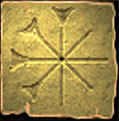
The Sumerian (Akkadian) cuneiform symbol an
(DIN.GIR),
which can mean "god", "heaven" and/or "star".
The Ainur of Middle Earth appear to have been named after the Anunna, the gods of the ancient Sumerians, whose name is based upon this symbol, indicating that Tolkien's linguistic expertise appears to have reached further afield than previously thought.
Image from
The Sumerian Home.
|
|
The Ainur were basically equivalent to the
angels
in the Middle Earth cosmogony. Their name was probably inspired by the
Anunna
of ancient Sumerian mythology, which was in turn based upon the Sumerian term
anu,
"god", "heaven" and/or "star", indicating that the Anunna were essentially heavenly beings.
Anu
was also the name of the high god of the early Sumerians (later replaced by
Enlil),
the word anu being represented by the symbol for "star" in the Sumerian hieroglyphic writing system.
Also like the "angels" of Sumerian cosmology, who were divided into two classes — the
Igigi
(lit., "the Watchers"), who were greater in power, and the
Annunaki
(lit., "angels who came down to earth") who were lesser in power — the Ainur of Tolkien's universe also were divided into two basic classes: 1) the
Valar,
of which there were fifteen, who were greater spirits similar in power and authority to the archangels, cherubim and ophanim of the Bible; and 2) the
Maiar,
a numerous assembly of lesser "angelic" spirits who, though less powerful than the Valar, were still very powerful. Most prominent among the Maiar were
Sauron,
who once served the Valar before
Melkor
turned him to the dark side, and
Olórin,
who during the Third Age came to Middle Earth in the guise of the wizard Gandalf in order to defend the free peoples of Middle Earth against Sauron and the other servants of Melkor.

The song of creation that these beings sang, directed by Ilúvatar, was actually made up of three major themes, each more powerful than the first. And though at first all sang in harmony with the primary theme of Ilúvatar, Melkor, the most powerful of the Valar, began to compose his own music within himself, and his music began to come into conflict with the music of the other Valar:
But now Ilúvatar sat and hearkened,
and for a great while it seemed good to him,
for in the music there were no flaws.
But as the theme progressed,
it came into the heart of Melkor
to interweave matters of his own imagining
that were not in accord with the theme of Ilúvatar;
for he sought therein to increase the power and glory
of the part assigned to himself.
To Melkor among the Ainur
had been given the greatest gifts of power and knowledge,
and he had a share in all the gifts of his brethren.
He had gone often alone into the void places
seeking the Imperishable Flame;
for desire grew hot within him
to bring into being things of his own,
and it seemed to him that Ilúvatar took no thought for the Void,
and he was impatient of its emptiness.
Yet he found not the Fire, for it is with Ilúvatar.
But being alone he had begun to conceive thoughts of his own
unlike those of his brethren.
Some of those thoughts he now wove into his music,
and straight-way discord rose about him,
and many that sang nigh him grew despondent,
and their thought was disturbed and their music faltered;
but some began to attune their music to his
rather than to the thought which they had at first.
|
|
|
|
|
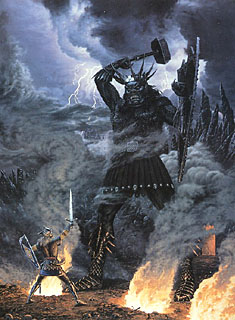
Melkor,
whose name means "he who arises in might", was the second most powerful being in the Middle Earth universe, next to Ilúvatar himself. Melkor represented the dark side of Ilúvatar, which he splintered off apparently in order to differentiate the good from the bad from within himself. Later named Morgoth ("The Black Foe of the World") after his rape of the
Silmarilli
(q.v.), Morgoth was essentially the Satan of the Middle Earth cosmology. Shown here is his famous duel with the great elven king
Fingolfin,
which, being immortal, he naturally won, but not without receiving several serious wounds from
Ringil
("cold star"), Fingolfin's powerful magical sword. Note the Silmarilli affixed to Morgoth's iron crown.
Image from
Galeria de Imagens Valinor.
|
Then the discord of Melkor spread ever
wider, and the melodies which had
been heard before foundered in
a sea of turbulent sound.
But Ilúvatar sat and
hearkened until it
seemed that about
his throne there
was a raging
storm.
15
Though Melkor, (lit., "He who arises in might") disrupted Ilúvatar's first theme by adding his own dissonant ideas into the divine symphony, Ilúvatar merely incorporated Melkor's discordant tones back into his original theme. And when Melkor's music became so discordant that it threatened to ruin the music all together, Ilúvatar switched to another theme not once, but twice, all the time turning Melkor's attempts to subvert his plan into parts of the overall song. Finally, when Ilúvatar's third theme came forth with overwhelming power, Melkor's crude attempt to subvert the will of Eru with his discordant music faltered, and he fell silent. And when the Song of Creation had ended, Eru revealed that Melkor's attempt to overcome his theme with loud, discordant music was part of his plan all along. Thus it appears that Tolkien's explanation for the problem of evil was that it exists because it serves a purpose. Evil, in his mind was, at least for a time, meant to perform an important role in God's salvation history; and those who do evil are blind to the fact that they are actually being used by God to achieve a greater good.

|
|
|
After the
Music of the Ainur,
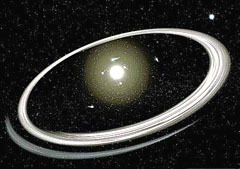
was completed, Ilúvatar showed to them what their music had created: the universe. Apparently Tolkien conceived of the universe as having been created — and still maintained — by a divine song, which will one day end. Tolkien correctly noted the essentially circular character of the universe, as shown here in a theoretical model of how our solar system formed, and how a ring is a perfect symbol for material power.
Image from
KidsGeo.com.
|
|
After the music had faded into the Void that surrounded them, Ilúvatar then revealed to the Ainur the universe that their music had made:
Ilúvatar said to them,
"Behold your Music!"
And he showed to them a vision,
giving to them sight
where before was only hearing;
and they saw a new world
visible before them,
and it was globed amid the Void,
and it was sustained therein,
but was not of it.
And as they looked and wondered
this World
began to unfold its history,
and it seemed to them that it lived
and grew.
And when the Ainur had gazed for a while and were silent,
Ilúvatar said again, "Behold your Music! This is your minstrelsy;
and each of you shall find contained herein, amid the design that I set before you,
all those things which it may seem that he himself devised or added.
And thou, Melkor, wilt discover all the secret thoughts of thy mind,
and wilt perceive that they are but a part of the whole and tributary to its glory." 16
In effect, Ilúvatar used the lesser beings that he had manifested from his own being to literally "sing" the universe into being. This makes sense, as most cosmogonies of the ancient world, such as the
Babylonian Creation Epic,
were not merely read, but actually sung, usually as part of their annual New Year's festivals. So, by having the "angels" of his "sub-creation" sing the universe into existence, Tolkien was being more faithful to the old traditions, including the biblical, than most theologians. It is in this way that Tolkien enciphered his belief of how the universe had actually been created into his sanctifying myth: through the medium of song.

But before we dismiss Tolkien as a heretic outright, let us examine how this concept of the universe being sung into existence is not entirely unbiblical:
Then the LORD answered Job out of the whirlwind, and said,
Who is this that darkeneth counsel by words without knowledge?
Gird up now thy loins like a man; for I will demand of thee, and answer thou me.
Where wast thou when I laid the foundations of the earth? declare,
if thou hast understanding.
Who hath laid the measures thereof, if thou knowest?
or who hath stretched the line upon it?
Whereupon are the foundations thereof fastened?
or who laid the corner stone thereof;
When the morning stars sang together,
and all the sons of God shouted for joy?
( Job 38:1-7 )
So the idea of the creation of the universe having been accomplished by (or at least accompanied by) a song, is not so farfetched. Indeed, it would appear that the Bible actually speaks of God being helped, or at least accompanied by, the angels as he laid the line and dropped the plumb so as to order the universe. In the Proverbs, God was actually accompanied by a person named "Lady Wisdom", whom some theologians believe refers to the Holy Spirit, God's divine "wife", who has been with Him since the beginning. In fact "She", according to
Proverbs 3:19, was actually used by God to create the Earth:
Happy is the man that findeth wisdom, and the man that getteth understanding.
She [wisdom] is a tree of life to them that lay hold upon her:
and happy is every one that retaineth her.
The LORD by wisdom hath founded the earth;
by understanding hath he established the heavens.
By his knowledge the depths are broken up, and the clouds drop down the dew.
( Proverbs 3:13, 18-20 )
Here, in Proverbs 3:19, God is not only accompanied by Lady Wisdom, he actually used her to "found the earth"! Therefore, the Holy Spirit appears to be the active part of God, His "body", that he uses to accomplish his goals.
Finally, the Melkor character has an obvious cognate in the biblical
Satan,
the greatest of the angels who rebelled against God and led many other angels into rebellion with him. Though there are many direct and indirect references to Satan in the Bible, perhaps the most relevant passage here can be found in
Ezekiel 28,
where a mysterious character named "the king of Tyre" is described as someone who once walked in Eden/heaven but, because of his iniquity, he was cast down to Earth. Interestingly, this mysterious king of Tyre was also associated with heavenly music:
|
|
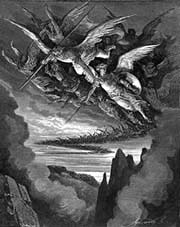
Azazel leading the rebel angels to Earth, as described in
The Book of Enoch.
The Book of Enoch
is an apocryphal but widely
respected work that is actually quoted in the Book of Daniel
(Daniel 7:9-10
/
Enoch 14:18-23)
and the Book of Jude,
(Jude 1:14-15
/
Enoch 1:9)
and alluded to in numerous other passages throughout the
Bible. The book, which is essentially an exposition of
(
Genesis 6,
details the coming down (or throwing down) of 200 angels from heaven to earth that occurred
in the world before the Flood, and how the teachings they brought to mankind led to mankind's downfall, the corruption of the whole earth, and
the necessity for its destruction by the Flood. The fall of Melkor and his corruption of many of the Maiar to his service as detailed in The
Silmarillion finds a ready cognate in the fall of Azazel (and Semjaza, the other leader) and the 200 other powerful fallen angels as detailed
in The Book of Enoch
Image from
Dore's Illustrations for "Paradise Lost" .
|
|
|
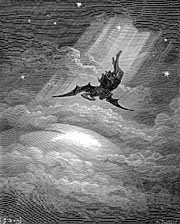
"Satan Falls" by Gustave Doré.
Satan's rebellion against God forced his expulsion from heaven. Melkor willingly left the "heaven" of Middle Earth, but his machinations were no less diabolical than Satan's. Satan and Azazel (op. cit.) are probably the same being.
Image from
Dore's Illustrations for "Paradise Lost".
|
Son of man, take up a lamentation
upon the king of Tyrus,
and say unto him,
Thus saith the Lord GOD;
Thou sealest up the sum,
full of wisdom,
and perfect in beauty.
Thou hast been in Eden the garden of God;
every precious stone was thy covering,
the sardius, topaz, and the diamond,
the beryl, the onyx, and the jasper,
the sapphire, the emerald, and the carbuncle,
and gold:
the workmanship of thy tabrets and of thy pipes
was prepared in thee in the day
that thou wast created.
Thou art the anointed cherub that covereth;
and I have set thee so:
thou wast upon the holy mountain of God;
thou hast walked up and down
in the midst of the stones of fire.
Thou wast perfect in thy ways
from the day that thou wast created,
till iniquity was found in thee.
By the multitude of thy merchandise
they have filled the midst of thee with violence,
and thou hast sinned:
therefore I will cast thee as profane
out of the mountain of God:
and I will destroy thee, O covering cherub,
from the midst of the stones of fire.
Thine heart was lifted up because of thy beauty,
thou hast corrupted thy wisdom
by reason of thy brightness:
I will cast thee to the ground,
I will lay thee before kings,
that they may behold thee.
Thou hast defiled thy sanctuaries
by the multitude of thine iniquities,
by the iniquity of thy traffick;
therefore will I bring forth
a fire from the midst of thee,
it shall devour thee,
and I will bring thee to ashes upon the earth
in the sight of all them that behold thee.
( Ezekiel 28:12-18 )
The description of Melkor can clearly be seen to have been largely inspired by this mysterious passage in Ezekiel. Not only is the wicked king of Tyre (and Satan, by extension) described here as having "tabrets" and "pipes" with which he apparently made heavenly music but also, like Melkor, he was the greatest of all the angels, and he too rebelled, thinking his own ideas to be even better than that of God. And as a result of the "multitude of his merchandise" and "the iniquity of [his] traffick" — the additional, unsanctioned ideas that Melkor added to his originally allotted part in the music — there was violent dissonance throughout heaven — i.e., war — which resulted in his expulsion. Also like Satan, Melkor burned inside with the desire to be like Eru, to misuse the Imperishable Flame to create things of his own original conception, a "fire in his midst" that devoured him and led him to self-destructive behavior that in turn inevitably led to his downfall. Finally Satan, like Melkor, was also associated closely with stealing fiery jewels, or "stones of fire" — a key part of The Lord of the Rings Cipher, as we shall see.
Introduction
|
J.R.R. Tolkien
|
The Song of Creation
|
The Shaping of Earth
Two Lamps, Two Trees, Two Witnesses
|
The War of the Jewels
|
Morgoth's Ring
LOTR_Cipher Notes
|
LOTR_Cipher Links
|
LOTR_Cipher Books
|
LOTR_Cipher Audio
LOTR_Cipher Video
|
LOTR_Cipher Collectibles
Editorial
|
Press Releases
|
Book Reviews
|
Fragments
Artifacts: The Exodus Revelation I
The Journey: Ireland I
|
Giants of Ireland
|
The Lord of the Rings Cipher I
Register
for our Hall of Records Newsletter
Questions? Comments? Suggestions? Advertising? Press Releases?
Contact us!

1
Ethan Gilsdorf,
"J.R.R. Tolkien and C. S. Lewis: A Literary Friendship and Rivalry"
(Literary Traveler: http://www.literarytraveler.com).
2
Wikipedia,
"Robert E. Howard"
(Wikipedia: http://en.wikipedia.org).
Howard, whom some feel was a great inspiration to Tolkien, created an entire world that he theorized actually existed "between the time when the oceans drank
Atlantis,
and the rise of
the sons of Aryas",
which he called the Hyborean Age. Though it was fairly well fleshed out, it lacked the subtle details such as non-human races and multiple languages that Tolkien actually created almost ex nihilo. Lovecraft and Moorcock also created their own universes in which their heroes fought and strove to make their mark, but Moorcock's characters, such as the classic Elric of Melniboné, were actually drawn purposely as anti-heroes specifically in order to contrast the writings of Tolkien and Howard.
3
Tom Shippey,
J.R.R. Tolkien: Author of the Century
(New York: Houghton Mifflin, 2000).
4
Humphrey Carpenter,
J.R.R. Tolkien: A Biography
(New York: Houghton Mifflin, 2000), 28-29.
5
J.R.R. Tolkien,
The Silmarillion
(New York: Houghton Mifflin, 2001), 87.
6
Carpenter,
Biography, 67, 97-98.
7
Carpenter,
Biography, 101.
8
Carpenter,
Biography, 83.
9
Bradley J. Birzer,
J. R. R. Tolkien's Sanctifying Myth: Understanding Middle-Earth (Wilmington, DE: ISI Books, 2002), 23-24.
10
Carpenter,
Biography, 99-101.
11
J. R. R. Tolkien, Christopher Tolkien ed.,
The Letters of J.R.R. Tolkien (New York: Houghton Mifflin, 1995), 144-145.
12
Carpenter,
Biography, 99.
13
Tolkien,
The Silmarillion, 3-4.
14
One of the reasons Tolkien had Fëanor the elf (q.v.) create three jewels may have been that he wanted them to symbolize the Holy Trinity — a God who was three, yet one.
15
Tolkien,
The Silmarillion, 4-5. Note that Melkor was the fifteenth and greatest of the Valar, but was removed from their ranks after falling from heaven.
16
Tolkien,
The Silmarillion, 6-7.
17
Text adapted from Ellie Crystal, "Ayer's Rock, Uluru" (Crystalinks: http://www.crystalinks.com/ayersrock.html). Cf. also
http://www.mysteriousworld.com/Journal/2002/Autumn/Atlantis/#TheOriginsOfMan.
18
Tolkien,
The Silmarillion, 10-12.
19
Tolkien,
The Silmarillion, 27-28.
20
Tolkien,
The Silmarillion, 31.
21
Wikipedia,
"Fëanor"
(Wikipedia: http://en.wikipedia.org).
22
Wikipedia,
"Fëanor".
23
Carpenter,
J.R.R. Tolkien: A Biography, 67, 101.
24
Carpenter,
J.R.R. Tolkien: A Biography, 101.
25
Silima may be based upon the Greek word
thelema,
"will", which
Aleister Crowley
used at length in his profane occult treatises. It was also used in the Bible to describe the "will" of God, so its function is not strictly negative in orientation. Tolkien probably intended to focus on the concept that Fëanor "willed" the jewels into existence, that they were a product of his and his alone. It is also interesting to note that at the heart of Buddism is the principle of
"The Three Jewels"
that Buddhists look to for guidance. Could this concept actually be the memory of three actual ancient jewels which had mysterious powers? Furthermore, could these three jewels have also been one of Tolkien's inspirations for the three Silmarilli?)
26
Rabbi Geoffrey W. Dennis,
"Tzohar" (Encyclopedia Mythica: http://www.pantheon.org/articles/t/tzohar.html).
27
Anonymous,
"The Tsohar" (Encyclopedia Mythica: http://www.indyfan.com/ark/tsohar.html).
28
See
"The Exodus Revelation"
previously in this issue for an in-depth discussion of the tsohar "firestones" and how they have played crucial roles throughout the history of mankind. It is interesting to note that the term "three jewels" is used frequently in
Masonic initiations,
as well as
Buddhist
teachings.
29
J. F. Sutton,
"The Atlantean Tuaoi Stone Revisited" (The Hutton Commentaries: http://www.huttoncommentaries.com/subs/Special/AtlanRec_Firestone/Tuaoi/ TuaoiRevisited.htm), edited for brevity. Note that Cayce's reference to "the entity" refers to his belief that he was able to communicate with spirit entities who had reincarnated themselves over and over again throughout history, even from the beginning of human history, so Cayce allegedly was able to find out about the past by questioning the spirit of the person asking for the "reading" where he or she was and what they were doing in the past. This was how he was allegedly able to find out so much about Atlantis — so many "entities" who had once lived in Atlantis reincarnated in the 20th century that Cayce was able to relate an enormous amount of information about that period of Earth's history.
30
For more information on the mysterious firestones in the Bible, see
"The Exodus Revelation" elsewhere in this issue.
31
Association for Research and Enlightenment A.R.E. ®, Inc.,
"Searching for the Hall of Records in the Yucatan" (Edgar Cayce's A.R.E.: http://www.edgarcayce.org/about_ec/cayce_on/ancient/search.html)
32
Geoffrey W Burr,
"Optical data storage enters a new dimension" (PhysicsWorld.com: http://physicsweb.org/articles/world/13/7/7);
see also
http://www.research.ibm.com/journal/rd/443/ashley.html;
http://en.wikipedia.org/wiki/3D_optical_data_storage;
http://en.wikipedia.org/wiki/Crystal;
http://en.wikipedia.org/wiki/Hologram;
http://en.wikipedia.org/wiki/Computer_storage#Optical_storage;
http://en.wikipedia.org/wiki/Holographic_Versatile_Disc.
33
See
http://www.t1shopper.com/tools/calculate/
for a conversion calculator to see how large a Petabyte is.
34
"Native American Legends: The Spider Woman and The Twins" (First People: http://www.firstpeople.us/FP-Html-Legends/TheSpiderWomanandtheTwins-Hopi.html).
Interestingly, in the Hopi myth of Spider Woman, the first thing she created were two twin males, Pöqánghoya and Palöngawhoya, which may be the Hopi version of the "two witnesses" concept discussed previously. Tolkien appears to have found some very deep correlaries in mythology, as far afield as the Desert Southwest of America. An important point to note is that Spider Woman brought life to the twins, and all plants and animals, through the use of something called a "white substance cape", which was "the creative wisdom itself". Could this be the same substance as the heavenly manna mentioned in the Bible? See
"Exodus Revelation"
for more on this critical subject.
35
Tolkien-Online.com,
"Morgoth's Ring" (Tolkien-Online.com: http://www.tolkien-online.com/morgoths-ring.html).
36
Carpenter,
J.R.R. Tolkien: A Biography, 101.
37
"Iron Crown of Lombardy" (Wikipedia: http://en.wikipedia.org/wiki/Iron_Crown_of_Lombardy).
38
"Lombards" (Wikipedia: http://en.wikipedia.org/wiki/Lombards). Cf. also
"Lombardy" (Wikipedia: http://en.wikipedia.org/wiki/Lombardy)
39
"Iron Crown of Lombardy" (Wikipedia: http://en.wikipedia.org/wiki/Iron_Crown_of_Lombardy). Cf. also
"Order of the Iron Crown" (Wikipedia: http://en.wikipedia.org/wiki/Order_of_the_Iron_Crown) and
"Charlemagne's "Iron Crown"" (Order of the Crown of Charlemagne in the United States of America: http://www.charlemagne.org/ic.html).
Charlemagne's father was named "Pippin the Short", probably where Tolkien took the name for the Hobbit "Pippin" in The Lord of the Rings. Theodolinda, the Queen of the Lombards, Germanic conquerors of northern Italy, was said to have found the crown. Was she the inspiration for Theoden of Rohan, or perhaps for Eowyn, who reigned after his death, or perhaps a combination of both?
(http://en.wikipedia.org/wiki/Theodelinda)
40
Carpenter,
J.R.R. Tolkien: A Biography, 72.
41
Carpenter,
J.R.R. Tolkien: A Biography, 72, 79, 83.
42
"Eärendil" (Wikipedia: http://en.wikipedia.org/wiki/Earendel).
43
Jimmy Dunn,
"Apophis (Apep), the Enemy of Re" (Wikipedia: http://touregypt.net/featurestories/apep.htm).
44
"Urim and Thummim" (Wikipedia: http://en.wikipedia.org/wiki/Urim_and_Thummim). Interestingly, the Mormons believed that their founder, Joseph Smith, had been led by an angel to find a cache of golden plates that could only be read with what the angel called "Urim and Thummim", which Smith described as essentially a pair of silver-rimmed glasses with smooth, three-cornered diamonds for lenses. Whereas this cannot be corroborated, the idea that the Urim and Thummim were essentially a pair of glasses that could be used to decipher encoded text is a very plausible one. Click here to read more about this fascinating theory.
45
"Urim and Thummim" (Jewish Encyclopedia: http://www.jewishencyclopedia.com/view.jsp?artid=52&letter=U).
46
"Oracles of God — The Urim and Thummim" (Israel Elect of Zion: http://www.israelect.com/reference/WesleyASwift/sermons/68-11-06.htm). Note that the author appears to be a racist, so take his teachings with a large grain of salt.
47
See
"The Exodus Revelation"
previously in this issue for an in-depth discussion of the tsohar "firestones".
48
"The Palantíri: The Stone of Osgiliath" (The Thain's Book: http://www.tuckborough.net/palantir.html#Osgiliath Stone). See also http://en.wikipedia.org/wiki/Palant%C3%ADr.
49
The seven palantiri "seeing stones" may correspond to seven mobile firestones that God uses to routinely survey the Earth and "keep an eye on things"
(Zech. 4:10).
One of these "eyes of the Lord" vehicles, each of which appear to be essentially a huge firestone on a square platform driven by a combination of four turbine engines ("wheels within wheels") on each corner, with
suction
to reduce drag (the word ayin, in Hebrew, incorrectly translated as "eyes" here, basically means "holes"), appeared in a vision to Ezekiel in
Ezekiel 1.
Basically, it appears that God sits on His heavenly throne and looks into the chief firestone on the heavenly Ark, which is hooked up to the seven mobile firestones, that transmit images back to Him so he can constantly survey the entire planet, just as the Kings of Gondor once used The Stone of Osgiliath in Tolkien's cipher.
50
Tolkien,
Silmarillion, 306.
51
"Dagor Dagorath" (Wikipedia: http://en.wikipedia.org/wiki/Dagor_Dagorath).
Selected Lord of the Rings-oriented content © The J.R.R. Tolkien Estate Ltd., EA Games or New Line Cinema, and is used for didactic purposes only. The terms "Lord of the Rings Cipher", "LOTR Cipher" and all original concepts and content are all © 2007 Doug Elwell, Inc. All Rights Reserved. All Bible quotations are taken from the New Kings James Version (NKJV) unless otherwise noted.


The Tolkien Society
TheOneRing.net
TheOneRing.net: Peter Jackson and New Line Cinema Join with MGM to Produce "The Hobbit" Movie
LordOfTheRings.net: The Official Movie Site
The Hobbit: The Official Movie Blog
Watchman Fellowship: Tolkien, Fantasy and Magic
The Lost Tolkien Novel
Internet Sacred Text Archive: Sources of Lord of the Rings
The Elvish Linguistic Fellowship: Resources for Tolkienian Linguistics
Ted Nasmith: The J.R.R. Tolkien Gallery
Arwen-Undomiel.com
T R A V E L:
Bloemfontein, South Africa (Tolkien's Birthplace)
Southern Africa Places: Bloemfontein
Mangaung Local Municipality: Bloemfontein - Botshabelo - Thaba Nchu
SouthAfrica.net: Bloemfontein — Heart of the Free State
SafariNow.com: Bloemfontein
Wikipedia: Bloemfontein
Wikitravel: Bloemfontein
Wikipedia: Orange Free State
Wikipedia: South Africa
Birmingham, England (Tolkien's Childhood Years)
Wikipedia: Birmingham, England
Birmingham City Council
Birmingham City Council: The Shire Country Park: Tolkien Weekend
Visit Birmingham
Britain Express: West Midlands
Wikipedia: West Midlands
Warwickshire County Council
Heart-of-England: Best Tourist Attractions in the Heart of England
Heart-of-England: Village of Sarehole
Heart-of-England: Dormston with Bag End
Heart-of-England: Tolkien's Warwickshire
Wikipedia: Sarehole
Wikipedia: Sarehole Mill
Birmingham Picture Library: Sarehole
Birmingham City Council: Sarehole Mill (w/map)
Birmingham City Council: The Shire Country Park
Birmingham City Council: The Shire Country Park: Tolkien Weekend
Birmingham City Council: Moseley Bog Local Nature Reserve
Shire Productions: Outdoor Theatre and Dramatisations of J.R.R Tolkien's Works
The Tolkien Society: Sarehole
Virtual Brum: Tolkien's Birmingham (pictures)
Tolkien Gateway: Sarehole
Tolkien Gateway: Sarehole Mill
Wikipedia: Edgebaston
Birminghamuk.com: Voice of the West Midlands
Birminghamuk.com: Edgebaston Tourist Information
Birminghamuk.com: Photographs of Edgbaston Birmingham
Birmingham Oratory
The Birmingham Oratory: Tolkien and the Oratory
Tours (Including Locations for the Films)
TheOneRing.net: Middle-Earth Tours
NewZealand.com: Lord of the Rings Tours
New Zealand Tourism Online: Lord of the Rings Tours
The Misty Mountains (Australia)


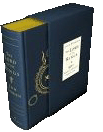 The Lord of the Rings (50th Anniversary Edition)
J. R. R. Tolkien
Rating:
The Fellowship of the Ring, part one of J.R.R. Tolkien’s epic masterpiece, fist reached these shores on October 21, 1954, arriving, as C. S. Lewis proclaimed, "like lightning from a clear sky." Fifty years and nearly one hundred million American readers later comes a beautiful new one-volume collector’s edition befitting the stature of this crown jewel of our list. With a text fully corrected under the supervision of Christopher Tolkien to meet the author’s exacting wishes, two large-format fold-out maps, a ribbon placemarker, gilded page edges, a color insert depicting Tolkien's own paintings of the Book of Mazarbul and exceptionally elegant and sturdy overall packaging housed within an attractive slipcase, this edition is the finest we’ve ever produced.
Click
here
to buy this book.
 The Silmarillion
J. R. R. Tolkien
Rating:
The Silmarillion is J.R.R. Tolkien's tragic, operatic history of the First Age of Middle-Earth, essential background material for serious readers of the classic Lord of the Rings saga. Tolkien's work sets the standard for fantasy, and this version of the "Bible of Middle-Earth" does The Silmarillion justice, conveying all the powerful events and emotions that shaped elven and human history long before Bilbo, Frodo, Gandalf and all the rest embarked on their quests. Beginning with the Music of the Ainur, The Silmarillion tells a tale of the Elder Days, when Elves and Men became estranged by the Dark Lord Morgoth's lust for the Silmarils, pure and powerful magic jewels. Even the love between a human warrior and the daughter of the Elven king cannot defeat Morgoth, but the War of Wrath finally brings down the Dark Lord. Peace reigns until the evil Sauron recovers the Rings of Power and sets the stage for the events told in the Lord of the Rings. This is epic fantasy at its finest, thrillingly and gloriously unabridged.
Click
here
to buy this book.
 Morgoth's Ring: The Later Silmarillion, Part One
(The History of Middle-Earth, Vol. 10)
J. R. R. Tolkien, Christopher Tolkien, ed.
Rating:
In Morgoth's Ring, the tenth volume of The History of Middle Earth and the first of two companion volumes, Christopher Tolkien describes and documents the legends of the Elder Days, as they were evolved and transformed by his father in the years before he completed The Lord of the Rings. The text of the "Annals of Aman", the "Blessed Land" in the far West, is given in full. And in writings never before published, we can see the nature of the problems that J.R.R. Tolkien explored in his later years as new and radical ideas, portending upheaval in the heart of the mythology. At this time Tokien sought to redefine the old legends, and wrote of the nature and destiny of Elves, the idea of Elvish rebirth, the origins of the Orcs, and the Fall of Men. His meditation of mortality and immortality as represented in the lives of Men and Elves led to another major writing at this time, the "Debate of Finrod and Andreth," which is reproduced here in full. "Above all," Christopher Tolkien writes in his foreword, "the power and significance of Melkor-Morgoth...was enlarged to become the ground and source of the corruption of Arda." This book indeed is all about Morgoth. Incomparably greater than the power of Sauron, concentrated in the One Ring, Morgoth's power (Tolkien wrote) was dispersed into the very matter of Arda: "The whole of Middle-earth was Morgoth's Ring." (From the book description)
Click
here
to buy this book.
 The War of the Jewels: The Later Silmarillion, Part Two
(The History of Middle-Earth, Vol. 11)
J. R. R. Tolkien, Christopher Tolkien, ed.
Rating:
In volumes ten and eleven of The History of Middle-earth, Christopher Tolkien recounts from the original texts the evolution of his father's work on The Silmarillion, the legendary history of the Elder Days or First Age, from the completion of The Lord of the Rings in 1949 until J.R.R. Tolkien's death. In volume ten, Morgoth's Ring, the narrative was taken only as far as the natural dividing point in the work, when Morgoth destroyed the Trees of Light and fled from Valinor bearing the stolen Silmarils. In The War of the Jewels, the story returns to Middle-earth and the ruinous conflict of the High Elves and the Men who were their allies with the power of the Dark Lord. With the publication in this book of all of J.R.R. Tolkien's later narrative writing concerned with the last centuries of the First Age, the long history of The Silmarillion, from its beginnings in The Book of Lost Tales, is completed; the enigmatic state of the work at his death can now be understood. A chief element in The War of the Jewels is a major story of Middle Earth, now published for the first time — a continuation of the great "saga" of Turin Turambar and his sister Nienor, the children of Hurin the Steadfast. This is the tale of the disaster that overtook the forest people of Brethil when Hurin came among them after his release from long years of captivity in Angband, the fortress of Morgoth. The uncompleted text of the Grey Annals, the primary record of The War of the Jewels, is given in full; the geography of Beleriand is studied in detail, with redrawings of the final state of the map; and a long essay on the names and relations of all the peoples of Middle Earth shows more clearly than any writing yet published the close connection between the language and history in Tolkien's world. The text also provides new information, including some knowledge of the divine powers, the Valar. (From the book description)
Click
here
to buy this book.
 The Shaping of Middle-Earth: The Quenta, the Ambarkanta and the Annals
(The History of Middle-Earth, Vol. 4)
The Shaping of Middle-Earth: The Quenta, the Ambarkanta and the Annals
(The History of Middle-Earth, Vol. 4)
J. R. R. Tolkien, Christopher Tolkien, ed.
Rating:
This is the fourth volume of The History of Middle-earth, edited by Christopher Tolkien, the first two comprising The Book of Lost Tales Parts One and Two, and the third The Lays of Beleriand.
It has been given the title The Shaping of Middle Earth because the writings it includes display a great advance in the chronological and geographical structure of the legends of Middle Earth and Valinor. The hitherto wholly unknown Ambarkanta, or "Shape of the World", is the only account ever given of the nature of the imagined universe, and it is accompanied by diagrams and maps of the world before and after the cataclysms of the War of the Gods and the Downfall of Numenor. The first map of Beleriand, in the North-west of Middle-earth, is also reproduced and discussed. In the "Annals of Valinor" and the "Annals of Beleriand" the chronology of the First Age is given shape; and with these are given the fragments of the translations into Anglo-Saxon made by Aelfwine, the Englishman who voyaged into the True West and came to Tol Eressea, the Lonely Isle, where he learned the ancient history of Elves and Men.
Also included are the original "Silmarillion," written in 1926, from which all the later development proceeded, and the "Quenta Noldorinwa" of 1930, the only version of the myths and legends of the First Age that J.R.R. Tolkien completed to their end. As Christopher Tolkien continues editing the unpublished papers that form the bedrock from which The Lord of the Rings and The Silmarillion were quarried, the vastness of his father's accomplishment becomes even more extraordinary. (From the book description)
Click
here
to buy this book.
 J.R.R. Tolkien: A Biography J.R.R. Tolkien: A Biography
Humphrey Carpenter
Rating:
Though he single-handedly gave a mythology to the English and was beloved by millions, John Ronald Reuel Tolkien remained refreshingly unchanged by his fame and fortune, living out his days simply and modestly among the familiar surroundings of Oxford College. Humphrey Carpenter, who was given unrestricted access to Tolkien's papers, brilliantly puts meat to the bones of the Tolkien legend in J.R.R. Tolkien: A Biography, offering a well-rounded portrayal of this quiet, bookish man who always saw himself first and foremost as a philologist, uncovering rather than creating the peoples, languages, and adventures of Middle-Earth.
Carpenter chronicles Tolkien's early life with a special sensitivity; after losing both parents, Tolkien and his brother Hilary were taken from their idyllic life in the English countryside to a poverty-ridden existence in dark and sooty Birmingham. There were bright points, however. A social and cheerful lad, Tolkien enjoyed rugby and was proud of his gift for languages. It was also at this time that he met Edith Bratt, who would later become his wife. Academic life — both as a student and professor — is where this biography shines. Friendship with other men played a huge part in Tolkien's life, and Carpenter deftly reveals the importance these relationships — his complex friendship with C.S. Lewis, membership in the Inklings and the T.C.B.S. — had on the development of his writing. (Review by Amazon.com)
Click
here
to buy this book.
 The Letters of J.R.R. Tolkien
J. R. R. Tolkien, Christopher Tolkien ed.
Rating:
Scholars and fans of the great mythologist will find a rich vein of information in Humphrey Carpenter's The Letters of J.R.R. Tolkien. Tolkien was a prodigious letter writer all his life; the sheer mass of his correspondence would give pause to even the most stalwart archivist (one shudders to think what he would have done with e-mail). But with the able assistance of Tolkien's son Christopher and a healthy dose of determination, Carpenter manages find the cream of the crop--the letters that shed light on Tolkien's thoughts about his academic and literary work, as well as those that show his more private side, revealing a loving husband, a playful friend, and a doting father. The most fascinating letters are, of course, those in which he discusses Middle-Earth, and Carpenter offers plenty of those to choose from. Tolkien discussed the minutia of his legend--sometimes at great length--with friends, publishers, and even fans who wrote to him with questions. These letters offer significant insights into how he went about creating the peoples and languages of Middle-Earth.
This new edition of letters has an extensive index, and Carpenter has included a brief blurb at the beginning of each letter to explain who the correspondent was and what was being discussed. Still, we strongly recommend buying the companion volume,
J.R.R. Tolkien: A Biography,
in order to better understand the place these correspondents had in Tolkien's life and get a better context for the letters.
(Review by Amazon.com)
Click
here
to buy this book.
 J.R.R. Tolkien: Author of the Century
Tom Shippey
Rating:
In a wonderfully readable study aimed at not just the Tolkien fan but any literate person curious about this fantasy author's extraordinary popularity, British scholar Shippey
(The Road to Middle Earth)
makes an impressive, low-key case for why the creator of Middle Earth is deserving of acclaim. (Recent polls in Britain have consistently put The Lord of the Rings at the top of greatest books of the century lists.) Having taught the same Old English syllabus at Oxford that his subject once did, Shippey is especially well qualified to discuss Tolkien's Anglo-Saxon sources, notably Beowulf, for the elvish languages and names used in the fiction. The author's theory on the origin of the word hobbit, for example, is as learned as it is free of academic jargon. In addition, Shippey shows that Tolkien as a storyteller often improved on his ancient sources, while The Lord of the Rings is unmistakably a work of its time. (The Shire chapters, like Orwell's 1984, evoke the bleakness of late-'40s Britain.) In treating such topics as the nature of evil, religion, allegory, style and genre, the author nimbly answers the objections of Tolkien's more rabid critics. By the end, he has convincingly demonstrated why the much imitated Tolkien remains inimitable and continues to appeal. (Review by Amazon.com)
Click
here
to buy this book.
 J.R.R. Tolkien's Sanctifying Myth: Understanding Middle-Earth
Bradley J. Birzer
Rating:
In a wonderfully readable study aimed at not just the Tolkien fan but any literate person curious about this fantasy author's extraordinary popularity, British scholar Shippey
(The Road to Middle Earth)
2002 brought a bumper crop of spirituality-of-Tolkien books, no doubt fueled by the heightened interest generated by the new film series. Birzer's book differs somewhat from recent volumes on the Christian themes to be found in The Lord of the Rings. Tolkien's spirituality, says Birzer, was not generically Christian but specifically Roman Catholic: the lembas that sustains the company represents the Eucharist; Galadriel and Elbereth exemplify traits of the Virgin Mary; and the company looks to the restoration of a kingdom similar to the Holy Roman Empire. The best chapter of Birzer's study explores how Tolkien's "sanctifying myth" was informed by such Roman Catholic beliefs; Tolkien told a Jesuit friend, for example, that the trilogy was "a fundamentally religious and Catholic work; unconsciously so at first, but consciously in the revision." Other chapters place Tolkien more generally within the usual canon of 20th-century Christian humanists, including his on-again, off-again friend, C. S. Lewis. Birzer is a fine writer who does a wonderful job of integrating primary sources such as letters, reminiscences and journals into his text; he also includes glimpses of unpublished materials, such as a scuttled LOTR chapter about Sam, as well as Tolkien's little-known attack on Lewis, "The Ulsterior Motive." This is, overall, a fine tribute to the man who, Birzer suggests, "resuscitated the notion that the fantastic may tell us more about reality than do scientific facts." (Review by Publishers Weekly)
Click
here
to buy this book.

 The Lord of the Rings: Motion Picture Trilogy Soundtrack
Howard Shore
Rating:
Howard Shore's music for the massively successful The Lord of the Rings: The Fellowship of the Ring, the first film chapter of Tolkien's Ring saga, won him the Oscar® for Best Original Score, something of a surprise given the music's ambitious scale and determinedly dark overtones, factors that handily blurred the line between typical film fantasy music and accomplished concert work.
Its sequel, The Lord of the Rings: The Two Towers, takes the same, often Wagnerian-scaled dramatic tack, following the film's story line into even more brooding and ominous dark corners. Fellowships' Hobbit-inspired pastoralism is supplanted in Towers by rich ethnic textures that expand the musical scope of Middle-earth and the World of Men. The score's looming orchestral clouds are brightened by Shore's masterful choral writing, which infuses ancient liturgical influences with various solo turns by Isabel Bayrakdarian, indie-pop star Sheila Chandra, Ben Del Maestro, and Elizabeth Fraser.
The final chapter of Peter Jackson's sprawling adaptation of Tolkien's "Ring" trilogy, The Lord of the Rings: The Return of the King closes out one of the most accomplished cycles in cinema — and film music — history. As he's done for the saga's first two installments, composer Howard Shore has honed a mature, brooding orchestral masterpiece that's long on subtle shadings of mood and nuance, while eschewing the hollow bombast that's characterized all too many mainstream action and adventure films for three decades. Shore uses his preternatural understanding of orchestral timbres and their almost mystical connections with human emotions to close out this remarkable trilogy with a Wagnerian dramatic sweep, tempered by a distinctly modern, understated melodic sense that is Shore's alone.(Review adapted from Amazon.com)
Click
here
to buy this CD.
 The Lord Of The Rings: Fellowship Of The Ring
(The Complete Recordings)
Howard Shore
Rating:
As fans of Peter Jackson's Lord of the Rings trilogy know, each film exists in two versions: the theatrical one and the extended one that appeared on DVD. This luxurious box set--which also comes with a detailed essay on the movie's musical themes — features the full extended score, so many cues not on the CDs of the individual movies are included. Granted, the majority of listeners will be perfectly happy with the shorter versions of the scores — it's a safe bet that most people can live without hearing, say, Ian McKellen's 35-second-long ditty "The Road Goes Ever On" at the beginning of "Bag End," or Viggo Mortensen's performance of his own composition, "The Song of Lúthien," within the track "The Nazgűl." But if you're a completist and/or a devotee of Howard Shore's pounding tympani and overwhelming choral compositions (featured particularly prominently on disc 3, a large chunk of which is devoted to a battle scene), then this set is a dream come true. Audiophiles should note that the fourth disc, a DVD, offers the score in Dolby Digital 5.1 Surround Sound. Fire up those speakers so the whole Shire can hear! (Review from Amazon.com)
Click
here
to buy this CD.
 The Lord Of The Rings: The Two Towers
(The Complete Recordings)
Howard Shore
Rating:
Where Fellowship Of The Ring dealt with the world of joyous hobbits and magical elves, Two Towers focuses on the decaying world of men, their desperate war against Saruman and Frodo's dreary journey through marshes and woods. Some lighter hobbit material provides a couple of comedic breaks during Merry and Pippin's storyline with Treebeard and the Ents, who are represented by a very particular sound texture of wooden percussion and a specific motif, which unfortunately mostly cut from the film, but which can be heard here in full form.
All in all, there are over a dozen new themes and motifs in this expanded version to fill in the blank spots for Rohan, Gondor, Fangorn, Gandalf The White and Frodo. Very noticeable, and very appropriately, in the expanded score is the extensive exploration of the Isengard material, whose 5/4 pattern is very invasive, spreads throughout the score and tries to take over other thematic material. Orchestration and composition of the theme are expanded as well, it's not as isolated as in Fellowship anymore, it feels alot more active.
Connected to that is Gandalf's resurrection. In "Gandalf The White", which heavily features unused music, the White Rider theme is introduced, which sounds like a beautiful, soaring contrast to the Isengard motif.
Frodo and Sam's journey, as soon as they encounter Gollum, is slowly getting dominated by his music. The Pity Of Gollum theme, already present in more conventional form in Fellowship, gets some serious workout, and not only that; Howard Shore expands it and defines a distinct Gollum sound, together with the cembalon. This hammer dulcimer is the weapon of choice for Gollum's evil "Stinker" motif, one of the many new themes for Two Towers. It can be heard prominently in "Lost In Emyn Muil" and on bassoon at the end of "The Tales That Really Matter". The set encompasses three CDs plus a DVD-audio disc featuring the score in four superior sound configurations. (Review from Amazon.com)
Click
here
to buy this CD.
 The Lord Of The Rings: The Return of the King
(The Complete Recordings)
Howard Shore
Rating:
The final film in The Lord Of The Rings blockbuster trilogy features the climax of the epic journey that brought Tolkien’s world before our very eyes. The Complete Recordings series featuring the soundtrack albums have been hits and award winners.
This five-disc set caps off the "complete recordings" series, which offers extensive versions of Howard Shore's score for The Lord of the Rings trilogy. Though it includes the climactic trek to Mount Doom, the overall mood is less dark than in The Two Towers. The London Philharmonic Orchestra handles the heavy lifting, with help from adult and children's choirs, and well-selected guest stars. Soprano Renée Fleming, for instance, lends a particularly eerie, otherworldly touch to disc 1's "The Grace of Undómiel," and disc 4's "Mount Doom" and "The Eagles." Meanwhile, flutist James Galway provides a quasi-spiritual counterbalance, a musical ray of hope on tracks such as disc 3's "The Mouth of Sauron." And of course, Annie Lennox's Academy Award–winning "Into the West" is here, incorporated in disc 4's "Days of the Ring." Finally, the fifth disc is a DVD-Audio that includes the score in super-duper surround sound. It may seem like overkill, but too much is never enough for LOTR fans — and besides, people buying this set are exactly the kind of people who own the type of equipment required to make disc 5 explode. Finally, the packaging includes new artwork and liner notes written by Doug Adams, an expert on the music from LOTR. (Review from Amazon.com)
Click
here
to buy this CD.

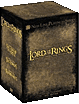 The Lord of the Rings - The Motion Picture Trilogy
(Platinum Series Special Extended Edition, 2004)
Rating:
The extended editions of Peter Jackson's The Lord of the Rings present the greatest trilogy in film history in the most ambitious sets in DVD history. In bringing J.R.R. Tolkien's nearly unfilmable work to the screen, Jackson benefited from extraordinary special effects, evocative New Zealand locales, and an exceptionally well-chosen cast, but most of all from his own adaptation with co-writers Fran Walsh and Philippa Boyens, preserving Tolkien's vision and often his very words, but also making logical changes to accommodate the medium of film. While purists complained about these changes and about characters and scenes left out of the films, the almost two additional hours of material in the extended editions (about 11 hours total) help appease them by delving more deeply into Tolkien's music, the characters, and loose ends that enrich the story, such as an explanation of the Faramir-Denethor relationship, and the appearance of the Mouth of Sauron at the gates of Mordor. In addition, the extended editions offer more bridge material between the films, further confirming that the trilogy is really one long film presented in three pieces. The scene of Galadriel's gifts to the Fellowship added to the first film proves significant over the course of the story, while the new Faramir scene at the end of the second film helps set up the third and the new Saruman scene at the beginning of the third film helps conclude the plot of the second.
To top it all off, the extended editions offer four discs per film: two for the longer movie, plus four commentary tracks and stupendous DTS 6.1 ES sound; and two for the bonus material, which covers just about everything from script creation to special effects. The LOTR extended editions without exception have set the DVD standard by providing a richer film experience that pulls the three films together and further embraces Tolkien's world, a reference-quality home theater experience, and generous, intelligent, and engrossing bonus features.
(Review by Amazon.com)
Click
here
to buy this DVD.

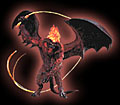 Lord of the Rings 24" Balrog with Sound
The most anticipated Lord of the Rings figure of all time! The Fire Demon Balrog is over 20" tall with a 3-1/2 foot wing span. Comes complete with sword and whip. This fully poseable figure includes ball jointed shoulders, bendable elbows, swivel wrists, and more. The eyes and flames on his back 'glow' with LED lights inside. (From the product description. Note that the red aura has been added for clarity against the black background and is not present in the actual product. Please read Amazon description and reviews before purchasing.)
Click
here
to buy this collectible.
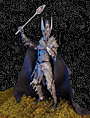 The Lord Of The Rings Fellowship Of The Ring 10" Sauron Deluxe
Rating:
The great evil who is seeking to rule Middle Earth has been masterfully crafted into a 10" action figure. Adorned in intricately detailed armor, Sauron features 16 points of articulation. He holds his evil mace and wears a shrouded back cape. Sauron wears "the one ring to rule them all," which is lost when his fingers are realistically severed. His eyes light up red as he electronically speaks four different phrases from the movie.
Click
here
to buy this collectible.
 The One Ring
Rating:
One Ring to Rule Them All. One Ring to Find Them,
One Ring to Bring Them All, And in the Darkness Bind Them!
The One Ring...Isildur's Bane, the Ring of Power...forged in the fires of Mount Doom by Sauron himself! Now you, too, can be a Ringbearer, if you dare...
Bearing the Black Speech of Mordor, transcribed into beautiful, flowing Elvish script which is laser engraved, these rings are reproductions of the One Ring you have seen in the movies, and are fully licensed by New Line. The Elvish script is both inside the rings as well as outside. Displayed in a rich wood treasure box, a certificate of authenticity accompanies this recreation of the One Ring to Rule Them All from The Lord of the Rings film trilogy. Now available in different sizes!
Click
here
to buy this collectible.
Editorial
|
Press Releases
|
Book Reviews
|
Fragments
Artifacts: The Exodus Revelation I
The Journey: Ireland I
|
Giants of Ireland
|
The Lord of the Rings Cipher I
Register
for our Hall of Records Newsletter
Questions? Comments? Suggestions? Advertising? Press Releases?
Contact us!
|