Editorial
|
Press Releases
|
Book Reviews
|
Fragments
Effigy Mounds II
|
Sea Serpents IV
|
Atlantis IV
Register
for our new Hall of Records Newsletter!
Questions? Comments? Suggestions? Advertising? Press Releases?
Contact us!
Mysterious Sea Serpents Part I: Nessie
|
Part II: Champ
|
Part III: Ogopogo
The Ancient Serpent
|
The Search Thus Far
|
The Lesser Nessies
|
The Search Continues
Sea Serpent Links
|
Sea Serpent Books
|
Sea Serpent Posters
 s we conclude our four-part series on mysterious sea serpents, it is now time to review the search thus far, and see what conclusions can be arrived at based upon our investigation. So far, we have studied
Nessie of Loch Ness,
Champ of Lake Champlain, and
Ogopogo of Lake Okanagan, and have concluded that all three of
these mysterious creatures share numerous characteristics, both in size, shape, appearance, and habitat.
Along the way we have also discussed the role of sea serpents in the religion, history and myths of both the ancient world and the modern, and have found striking parallels between the myths of many different cultures, some separated from each other by both thousands of miles, and thousands of years.
s we conclude our four-part series on mysterious sea serpents, it is now time to review the search thus far, and see what conclusions can be arrived at based upon our investigation. So far, we have studied
Nessie of Loch Ness,
Champ of Lake Champlain, and
Ogopogo of Lake Okanagan, and have concluded that all three of
these mysterious creatures share numerous characteristics, both in size, shape, appearance, and habitat.
Along the way we have also discussed the role of sea serpents in the religion, history and myths of both the ancient world and the modern, and have found striking parallels between the myths of many different cultures, some separated from each other by both thousands of miles, and thousands of years.

|
|
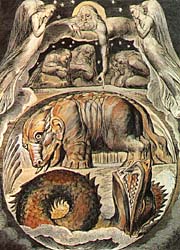
"The Behemoth and the Leviathan", by William Blake (1757-1827), based on
Job 40-41. In the Book of Job, Behemoth is described as the greatest of land beasts, as opposed to Leviathan, who is the greatest
of sea beasts. The current text of Job does not specifically say that Behemoth is the enemy of God as it does of Leviathan, though future
translations may show otherwise.
Image from
Encyclopedia Mythica.
|
Over and over again, we have seen the sea serpent at the center of ancient myths and legends as the representative of the forces of chaos,
evil and, frequently, as the enemy of the chief deity of the pantheon. Whether appearing as the implacable enemy of the
Thunderbird,
as Jormangund the world-serpent who will fight against the
Norse gods
at the last battle of
Ragnarok,
or as the mighty
Leviathan
who fought God at the Creation and will return again to fight God at the
Apocalypse,
sea serpents perform a critical function in the legends of our ancient ancestors as the ambassadors of chaos, of evil, and of destruction.
Ancient
Canaanite myths
make reference to
Lotan, "the serpent tortuous", whose name and description is
a close match for the biblical
Leviathan.
Moreover, just as the sea dragon
Leviathan
is portrayed in the Bible, the sea dragon Lotan
represents both the deep sea and the chaos it represents. In both stories, the Hebrew and the Canaanite, the dragon represents a threat
to the established order as mandated by the heavenly gods (or God, in the monotheistic Hebrew religion), and in both stories the dragon
is slain and its carcass used to form the heavens and Earth.
Next to the Bible, the most well known document that makes reference to the ancient sea serpent is The Babylonian Creation Epic,
Enuma Elish, which has as its main antagonist a dragon goddess named Tiamat. The name "Tiamat" was derived from the ancient Akkadian word tehom, "deep sea", with the addition of the feminine suffix "-at", making Tiamat literally "lady sea". This same word tehom, like Lotan, has a biblical cognate word in the Hebrew tehom, which also means "deep sea". In the Babylonian Creation Epic, the dragon-goddess Tiamat emerges from the primordial sea, a primal matrix which which she is closely associated.
|
|
|
|
|
|
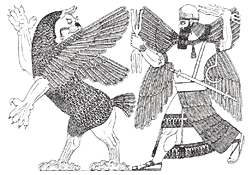
An Assyrian relief depicting the battle between Marduk and Tiamat. Marduk (right) defeated Tiamat and created heaven and Earth from
her dead body. This combat motif lay at the center of ancient Mesopotamian concepts of the Creation, and may have also influenced the
biblical account.
Image from
Kings of Mesopotamia: 12 Days of Nissan.
|
|
She then gives birth to the gods, but after they prove to be troublesome, she turns on them and tries to destroy them. Her children then ask an outsider, the god
Marduk,
to vanquish their crazed mother and save them from destruction. Marduk then defeats Tiamat in combat and creates heaven and Earth from her corpse, a story with close parallels to both the Hebrew, Canaanite, Hittite, Egyptian and Vedic Indian creation stories, among others.
The
Norse myths
describe a gigantic sea serpent referred to as Jormangund, or
"The Midgard Serpent",
which lives under the sea,
circling the world at the equator. One of the children of the evil god Loki and the giantess Angur-Boda, Jormangund began to grow so huge that Odin, fearing its great size, threw the great serpent down from heaven to the sea. There Jormangund grew so huge that it circled the world at the equator, its movements creating storms and tsunami. At the final battle of
Ragnarok,
"The Twilight of the Gods", Jormangund will side with the giants in an attempt to defeat the Norse gods, and will die at the hands of Thor,
Odin's son. This of course has close parallels with the biblical prophecy that Leviathan would arise again at the end times and would be
finally destroyed by God at that time, though clearly the Leviathan of the Bible is, rather than being an actual creature, symbolic of
something more sinister.
The ancient sea serpent also has an important role in the Bible as the enemy of God. Mentioned throughout the Bible, the ancient serpent
consistently plays the role of antagonist in the divine drama. Though theologically the ancient serpent is a symbolic incarnation of the
powers of evil, the serpent is also, mysteriously, in some way physical as well, embodied in the power of the supercaelian sea. The ancient
serpent is
|
|
|
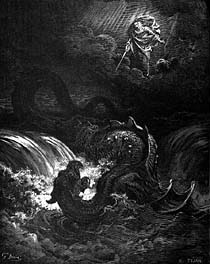
"In that day the Lord with His sore and great and strong sword shall punish Leviathan, the piercing serpent,
even Leviathan, that crooked serpent; and he shall slay the dragon that is in the sea."
(Isa. 27:1, KJV)
|
described variously as "the crooked serpent"
(
Job 26:13;
Isa. 27:1),
"the dragon"
(
Psalm 74:12-17;
Isa. 27:1,
51:9-15,
Rev. 12);
Leviathan
(
Job 41,
Psalm 74:12-17,
104:26;
Isa. 27:1);
Rahab
(
Psalm 89:8-11;
Isaiah 51:9-15)
and, simply as "the serpent"
(
Gen. 3;
Amos 9:3;
cf.
Rev. 20:2).
His (her?) role in the Bible is that of the enemy of God, opposing His will, thwarting His attempts to impose heavenly rule upon Earth. Whether it is called the "crooked serpent", Leviathan or Rahab, the story is consistent. The ancient sea serpent fought against God at the Creation and lost, God then using its body to create heaven and Earth. However, though the ancient serpent was defeated and subdued, it was not totally destroyed. Both she and her progeny, the mysterious sea serpents, live on as subdued, relatively docile creatures
(Ps. 104:25-27).
At the time of the end, however, the ancient sea serpent will revive its old enmity with God to battle Him once again for dominion over the Earth
(
Isa. 27:1;
Rev. 12-13).

Thus far we have examined the three most well-known mysterious sea serpent legends on Earth:
Nessie of Loch Ness,
Champ of Lake Champlain, and
Ogopogo of Lake Okanagan.
In that search we discovered that each of these mysterious creatures share several points in common, including their relative size, shape,
physiognomy, habits and habitat. All three of these creatures are frequently described as being very large, with long, thin necks, large
flippers, and thin, undulating, serpentine bodies.
To summarize, through our analysis in Parts
I,
II
and
III
we found that they had the following characteristics in common:
|
|
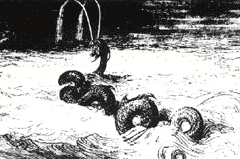
"A Sea Serpent Sighted off the Jersey Shore," from the New York World, 1880.
(Illustration from Down Barnegat Bay, A Nor'easter Midnight Reader, by Robert Jahn)
This is a typical example of how "sea serpents" were portrayed in literature during the Victorian Period. Note that unlike sea snakes,
which only slither from side to side in a predictble pattern, this serpent appears to be coiling in more of a random, corkscrew fashion.
Image from
Pineylore: The Serpent of Long Beach Island.
|
 Their bodies are thin and serpentine, though some reports describe the body as wider in the middle;
They range in length anywhere from 20-60 feet or more, and in width they are often described as being "about as wide as a barrel", sometimes as much as two barrels;
They have a horselike head on a long neck that can be raised above the water in periscope fashion;
They have "humps" that appear above water when they swim. These humps undulate up and down, which is unlike the slithering motion of snakes, which is always side to side;
Many sightings mention flippers and a whale-like tail that they use for propulsion;
They are capable of moving on land for short periods of time;
They need to surface to breathe air, but can remain submerged for extended periods of time;
They are carnivorous, eating anything from fish to humans, though they tend to flee when approached;
They can live in fresh or salt water, but seem to prefer deep, glacial lakes, possible because they were trapped there by receding waters at the end of the last Ice Age;
They appear to greatly dislike being photographed;
In
Part III,
we discussed the above data and determined the following: Nessie and her brood could not be true "serpents", or any type of reptile, as
reptiles cannot undulate in a vertical fashion, only horizontally. This also disqualifies plesiosaurs, as they have a rigid construction
and are unable to undulate at all, either vertically or horizontally. This leaves us only three alternatives:
A
mosasaur
A
zeugledon
or related
prehistoric whale;
A previously undiscovered form of serpentine animal life
Unfortunately, unless all of the sea serpent sightings around the world are actually of different types of creatures, we will have to
eliminate mosasaurs and zeugledons because, though they had flippers and flukes, and fit into the size range, neither mosasaurs nor
zeugledons had long necks with horselike heads, which is one of the most commonly reported features of these creatures. Also, though
their swimming motions were vertical, they would not "undulate" as some have described the motion. We must therefore conclude that these
mysterious sea serpents are some form of previously unknown creature.
Let us now examine reports of other sea serpent sightings around the world, the "lesser Nessies", in order to see if we can shed some
additional light upon this subject:

There are literally hundreds of other USOs (Unidentified Swimming Objects) to be found around the world, though by far the best documented
cases have been, as we have seen, in the West: in the UK (Nessie), the USA (Champ) and Canada (Ogopogo). Many other of these "lesser Nessies"
have been spotted both in inland lakes and in the sea, usually just offshore near tourist resorts or, more frequently, by ships in the open
sea. Let's take a closer look at several of the most prominent and unusual of these USOs and see if we can gain a more thorough
understanding of the mysterious sea serpent phenomenon:

|
|
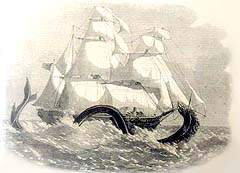
Image of a sea serpent that allegedly attacked a sailing vessel, the British Banner, on April 25, 1859. The creature in this
image matches the description of the Gloucester sea serpent, including the horn on the creature's head.
Image from
The Museum of Hoaxes: "The Gloucester Sea Serpent".
|
Class: Sea Serpent
Length: 60+ feet
Width: Unknown
Country: USA
Body of Water: Atlantic Ocean (along America's east coast, particularly around Gloucester Bay, Massachusetts)
Nearest City: Gloucester, Mass.
Description:
Also known as
The Gloucester Sea Serpent,
The Great New England Sea Serpent (let's call her "Gnessie" for short), was a serpentine creature that has been seen in the Atlantic Ocean all
up and down the New England seaboard by "many respectable persons" for hundreds of years. According to J.P. O'Neill, in her seminal work,
The Great New England Sea Serpent: An Account of Unknown Creatures Sighted by Many Respectable Persons between 1638 and the Present Day,
In August 1817, members of the New England Linnaean Society found themselves in the unique position of conducting the first ever scientific investigation of an unknown marine creature, supposed to be a sea serpent, that had appeared in the harbor at Gloucester, Massachusetts.... Eager to "collect evidence with regard to the existence and appearance of any such animal", the members of the investigative committee
of the Linnaean Society set about gathering sworn statements from a variety of credible witnesses.... As recorded in the published report of the Linnaean Committee in 1817, the witnesses' accounts agreed that the creature "was said to resemble a serpent in its
general form and motions, to be of immense size, and to move with wonderful rapidity; to appear on the surface only in calm bright weather;
and to seem jointed or like a number of buoys or casks following each other in a line." Similar descriptions of a creature bearing little resemblance to any known animal had been reported as early as 1638 and would be repeated over and over again for the next 150 years.1
One of the most detailed recordings of a sighting of Gnessie by a Western observer was in July 1802 by a minister named Abraham Cummings. Cummings described the creature as "in the form of a serpent.... This creature had not the horizontal, but an ascending and descending serpentine motion. This renders it highly probable that he never moves on land to any considerable distance and that the water is his proper element. His head was rather larger than that of a horse, but formed like that of a serpent. His body we judged was more than sixty feet in length."2 Once again, the sea serpent profile does not fit any known type of animal.
Where to See It: Gloucester, Massachusetts is 30 miles north of Boston, and is easily accessible by car or train. The stunning, rugged beauty of Gloucester's coastline, the long, sandy beaches and the clear blue Atlantic Ocean have attracted visitors since
Samuel de Champlain
sailed into Gloucester Harbor in 1604 and christened it "Le Beau Port". An attractive downtown, museums and tours on land and sea all make it a great destination. To receive your free brochure packet, please call 1-800-649-6839, write the Gloucester Tourism Office, 22 Poplar Street, Gloucester, MA 01930, send them an
email,
or visit their
website.
Gnessie Links

|
|
|
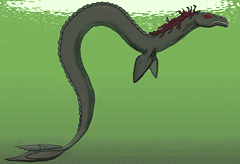
Illustration of Caddy by David John, based on LeBlond/Bousfield composite and eyewitness accounts.
Image from
The Cadborosaurus Watch.
|
|
Class: Sea Serpent
Length: 40-50 feet
Width: Unknown
Country: Canada
Body of Water: Pacific Ocean (Cadboro Bay, near Vancouver Island, B.C.)
Nearest City: Victoria, British Columbia
Description:
In the Pacific Ocean, all along the Pacific Northwest and particularly near Vancouver Island in British Columbia, Canada lives the
Cadborosaurus, or
"Caddy".
Named after Cadboro Bay, which is between Vancouver Island and the British Columbian mainland, Caddy fits the classic "sea serpent"
profile. As Rosemary Ellen Guiley explains in
The Atlas of the Mysterious in North America,
Dr. Paul LeBlond ... and Dr. Edward L. Bousfield report strong evidence for the recognition of a "very large marine cryptid" and "distinct vertebrate species" in these waters. Their description, based on 100 years of reported sightings and photos, is of a 40- to 50-foot long (10- 15-foot juvenile) flippered animal embodying 'major characteristics of both Reptilia and Mammalia, but is not clearly classifiable within existing subcategories of either.' The apparently harmless creature has been described over the years as snakelike or whalelike, with a greenish-brown, serrated undulating body, and a camel-like head.3 [This description is very similar to that of
Ogopogo,
whose habitat is nearby Lake Okanagan.]
Caddy was first encountered by locals in the 1920s, when he was referred to as "the Sea Hag" because of the fear he inspired. However, the editor of the local newspaper, the Victoria Times, began to promote the beast as a local mascot, and started a contest to rename it. The name "Cadborosaurus" was selected, and "Caddy" caught on quickly around the Cadboro Bay area. Locals have embraced Caddy as one of their own, and the creature has become an integral part of the area's history. Caddy has become a favorite of locals, who now guard him fiercely.4
Where to See It: Caddy roams the entire Pacific Northwest coast, but is most often seen in the waters between Vancouver Island and the
British Columbian
mainland. Searchers are most likely to see Caddy from one of the many
boat tours
offered by local companies, but can also see him from the shores of the city of
Victoria
on Vancouver Island, or from nearby Chatham Island.
Caddy Links

|
|
|
|
|
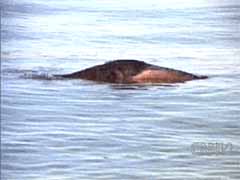
An image of The Lake Van Monster, from a video shot in 1997 by then 26-year-old Unal Kozak, of Van, Turkey. The image shows the
creature's head partly submerged, with a single black eye staring at the camera. Note the upper jaw of the creature's mouth, which
appears to be beaklike in nature. Highlights of Kozak's video are available courtesy of
CNN.com.
|
|
Class: Lake Monster
Length: 50+ feet
Width: Unknown
Country: Turkey
Body of Water: Lake Van
Nearest City: Van
Description:
One of the best recorded lake monster sightings in the world today is the creature known as
The Lake Van Monster.
First seen in 1995 by residents of
Van, Turkey,
the creature has been a subject of significant scrutiny by both amateur and professional explorers, including the Turkish government.
After the provincial deputy governor saw the creature, describing it as "just like in cartoons. It was black and had
triangular spikes on its back. It looked like a dinosaur,"5 a parliamentary commission was set up to
formally search for it.
The most famous and well documented sighting was made in 1997 by a Van University teaching assistant named Unal Kozak. Kozak had been
searching for the creature obsessively for years, and had finally caught it
on video.
In the video, the creature can be seen moving rapidly, with its head and several "humps" appearing above the water. The last part of
the video shows a closeup of the creature's head, its large, black eye staring intently at the camera. Also noteworthy in the image is
the creature's upper jaw, which appears to be beaklike in nature, being of a different color and texture than the skin on other parts
of the creature's body that are visible in the video. Kozak has also written a book on the creature that documents over 1,000 sightings
of the creature by various witnesses over the years, wherein he estimates the creature to be approximately 50 feet in length.
Where to See It: The Lake Van Monster is located in
Lake Van,
near the city of
Van,
Turkey.
Turkey
is generally considered the most modern and western of the middle eastern states, despite the fact that its population is predominately Muslim. As of the writing of this article (Spring 2003), the Iraq war has greatly heightened tensions between the United States and Turkey, so
travel to Turkey,
(particularly for U.S. and British citizens) is strongly discouraged at this time. Consult the
U.S. State Department's Turkey travel advisories
for regular information and updates on travel safety in Turkey.
Lake Van Monster Links

Class: Lake Serpent
Length: 15-150 feet
Width: Unknown
Country: Argentina
Body of Water: Nahuel Huapi Lake
Nearest City: Bariloche
Description:
The southern hemisphere also has its share of mysterious reptilian cryptids.
Nahuel Huapi Lake,
near
Bariloche
in
Argentina
plays host to
Nahuelito.
Nahuelito has been in the public consciousness since the 1920s, when Dr. Clementi Onelli, the director of the Buenos Aires Zoo, received a
report of "huge tracks and crushed bushes and undergrowth leading to an unnamed lake shore." Other sightings describe a crocodile-like
creature with a swan-like neck. Sir Arthur Conan Doyle's classic novel
"The Lost World"
was also serialized in the popular magazine The Strand at that time, describing a creature very similar to Nahuelito, which appears
to have launched Nahuelito to his current fame.
Though
The Lost World
brought great attention to Nahuelito, sightings of Nahuelito predated the book by decades, and continue to this day.
Nahuelito has occasionally been visible for several minutes on the surface of the lake and has been sighted by scores of tourists and locals.
Descriptions have varied from that of a giant water snake with humps and fish-like fins to a swan with a snake's head, the overturned hull
of a boat, and the stump of a tree. Estimates of the creature's length range from 15 to 150 feet. Nahuelito is said to surface only in the
summer, when the wind is still. Witnesses say that a sudden swell of water and a shooting spray precede the surfacing of the
creature.6
Where to See It: Nahuelito lives in
Nahuel Huapi Lake,
near the popular resort town of
Bariloche,
Argentina.
There is a
national park,
with
hiking,
skiing,
fishing
and a variety of other activities, including
guided tours.
Nahuelito can be viewed year round, but is most likely to be seen in the heat of summer when the wind is still, and the lake is calm and
smooth, "like oil".
At those times, watch for the spray of steam that usually precedes Nahuelito's dramatic surfacing.
Nahuelito Links

|
|
|
|
|
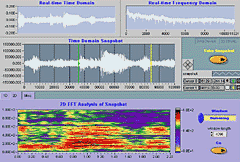
An image of the computer display of the audio file of the "grunt" sound recorded by Jan Sundberg of GUST (Global Underwater Search
Team) in 1999 in Lake Seljordsvatnet, Norway. The sound has been independently verified by a professionals as
coming from a large underwater creature. Image from
GUST.
|
|
Class: Lake Monster
Length: 10-40 feet
Width: Variable
Country: Norway
Body of Water: Lake Seljordsvatnet
Nearest City: Seljord, Telemark County
Description:
Lake Seljordsvatnet, near Seljord, Norway, also has its own lake monster that locals have dubbed "Selma".
The first recorded sightings of Selma
date as far back as 1750, when she attacked a small boat. There were numerous sightings of the creature during the 1800s, the most prominent of
which was a story where Selma was apparently on land, and a woman cut her in half. While the front half remained on the shoreline and was left
to rot, the rear half, according to the story, slithered back into the lake. Since that first sighting of Selma in 1750, there have been over
100 reported sightings of Selma.
These sightings describe Selma as being anywhere from 10-40 feet, black in color, and thicker around the middle. "The common view seems to be
that she has big black eyes, a head like a horse without ears, is black all over, and has a considerably thicker middle region that includes
flippers."7 This does not sound like the conventional sea serpent, but more like a plesiosaurus, as some have
conjectured the
Loch Ness Monster
to be.
In 1999, Jan Sundberg of
GUST
(Global Underwater Search Team) went to Lake Seljordsvatnet with underwater microphones to see if any
large animal noises
could be recorded, and was successful in doing so.
Sundberg returned in 2000
with a
specially designed trap
in order to trap an immature example of the species for study. To date, however, Selma remains at large.
Where to See It: Selma is located in Lake Seljordsvatnet, near
Seljord,
in
Telemark County,
Norway.
Telemark
is known for its skiing, scenic beauty, culture and diverse landscape. Selma hunters should aim to visit the lake during the summer, as the
winter ice remains on the lake well into the spring, and starts to form early in the autumn.
Selma Links

The list of the "lesser Nessies" is seemingly endless, some counts listing the number of recognized sea serpents, lake serpents, and various
aquatic monsters around the world to be over 250. Following is a list of some of the most popular and well known creatures. Though there are
many more, we have decided to limit the list to creatures that have at least one web page devoted exclusively to them. The list is long, so
feel free to
skip ahead
to the conclusion of this article.

Class: River Serpent
Length: 10-40 feet
Width: 1-2 feet
Country: USA
Body of Water: Altamaha River
Nearest City: Darien, Georgia
Description: Altamaha-Ha is named after the Altamaha River near Darien, Georgia. Despite its freshwater abode, it is a classic "sea serpent" in appearance. Recorded sightings of Altamaha-Ha began in the 1960s, and continue to this day. Altamaha-Ha has also been sighted in areas nearby Darien.
Altamaha-Ha Links

Class: Lake Serpent
Length: 17-35 feet
Width: Unknown
Country: USA
Body of Water: Lake Erie
Nearest City: Cleveland, Ohio
Description: "South Bay Bessie", or "Lem" (short for Lake Erie Monster) has been sighted in the southern section of Lake Erie as
far back as 1793, when a local hunter saw a "17-foot snakelike beast" rise up from the water. Another appearance in 1873 inspired the formation of a posse. More recently, local businessmen have put a bounty on her head, which has since been dropped, likely to keep overzealous bounty hunters from causing chaos. Bessie has made it to the cover of Weekly World News, and one intrepid monster hunter has even built a trap specifically for her. Huron City has declared themselves the "live capture control center for the Lake Erie monster", and interest in the creature continues to this day.
Bessie Links

Class: Sea Serpent
Length: 25-40 feet
Width: 2-4 feet
Country: USA
Body of Water: Atlantic Ocean (Chesapeake Bay)
Nearest City: Annapolis, Maryland
Description: Chessie of Chesapeake Bay, off the coast of Maryland, has been the subject of increasing speculation over the past 20 years. Chessie is typically described as serpentlike, with an "elliptical or football-shaped head" and no fins or appendages. Since 1982, The Enigma Project, a private, Maryland-based, association of scientifically trained and technically oriented individuals who investigate and document claims of unexplained phenomena, has been closely following all reported sightings of Chessie. Recently, however, a manatee was discovered in the bay, having wandered far north from its Florida home, causing many to conclude that the sightings of "Chessie" were actually a combination of manatee sightings and wishful thinking. Hope springs eternal, however, for fans of Chessie the Sea Serpent.
Chessie Links

Class: Sea Serpent
Length: 40+ feet
Width: Unknown
Country: USA
Body of Water: Pacific Ocean (Mouth of Oregon River)
Nearest City: Astoria, Oregon
Description: Colossal Claude was first sighted in 1934 near the mouth of the Columbia River, which runs along most of the border between
Oregon and Washington state. The sailors who sighted Claude at that time described him as being 40 feet long, with an eight-foot neck, a
round body, "a mean looking tail and an evil, snaky look to its head." Other sightings give further details, describing Claude as having
coarse gray or tan fur, a head shaped like that of a camel or of a horse, glassy eyes, and a bent nose that he uses to scoop up fish. Several
other odd creatures have been sighted in the vicinity also, but Claude has not had any recorded sightings since the 1950s. Claude t-shirts and
mugs are likely still sighted along the shores of the Columbia, however, particularly in Astoria.
Colossal Claude Links

Class: Lake Serpent
Length: 15-20 feet
Width: Unknown
Country: USA
Body of Water: Flathead Lake
Nearest City: Polson, Montana
Description: Flathead Lake in Montana has its own creature. First spotted in 1889, the Flathead Lake monster has been spotted regularly
up to the present day. Some appearances may have been sturgeon or giant catfish, but other sightings describe humps and a distinct head, with
a body up to 20 feet in length. No expense was spared in the marketing of this creature either.
Flathead Lake Monster Links

Class: Lake Monster
Length: Unknown
Width: Unknown
Country: Sweden
Body of Water: Lake Gryttjen
Nearest City: Ljusdal
Description: Lake Gryttjen in the center of Sweden, between the cities of Hudiksvall and Ljusdal, has long had a reputation of mystery. Though beautiful, it has been the subject of rumors and tales for decades. One rumor has it that a type of sea cow lives in the lake, but no examples have yet come to light.
Gryttie Links

Class: Lake Serpent
Length: Unknown
Width: Unknown
Country: USA
Body of Water: Lake Hodges
Nearest City: San Diego, California
Description: Hodgee is a creature that has rarely been seen, yet there have been significant attempts to capture him. One such attempt in 1932 was quite elaborate, with the creation of a huge steel cage, complete with a sea lion as bait. However, though the sea lion disappeared, no monster was captured. No further attempts to capture the creature have been made to date, though some interesting photographs have been taken.
Hodgee Links

Class: Lake Serpent
Length: 9-12 feet
Width: Unknown
Country: Canada
Body of Water: Lake Simcoe
Nearest City: Toronto, Ontario, Canada
Description: Igopogo, a name inspired by its more famous cousin,
Ogopogo,
can be found in Lake Simcoe, just an hour's drive north of Ontario. Igopogo is less shy than other lake serpents and does not appear to be afraid of humans, often startling picnickers on the shore or fishermen in boats as it innocently creeps up on them. Igopogo is described as having a "stove-pipe" neck and a head resembling that of a large dog. Though popular belief has it that Igopogo is a type of lake serpent, theories have recently arisen that she is actually a form of large seal.
Igopogo Links

Class: Lake Serpent
Length: 40-60 feet
Width: Unknown
Country: USA
Body of Water: Lake Murray
Nearest City: Irmo, South Carolina
Description: Also known as "Messie", sightings of the Lake Murray Monster started in 1933 when residents of Irmo, South Carolina and Ballentine saw a Nessie-like creature. There have been sightings almost every year since then. Described as "a cross between a snake and something prehistoric", Messie has been known to be aggressive, charging fishermen, and even attacking one couple, who were forced to fight it off with a paddle. At 41 miles long, 14 miles wide and 380 feet deep, Lake Murray is comparable in size to lakes Ness, Champlain and Okanagan, so a creature the size of 40-60 feet long is not impossible. The lake also contains adequate biomass to sustain a creature of that size.
Lake Murray Monster Links

Class: Lake Monster
Length: Unknown
Width: Unknown
Country: USA
Body of Water: Lake Norman
Nearest City: Mooresville, North Carolina
Description: For years, people around Lake Norman near Mooresville, North Carolina have been reporting sightings of strange shapes in the water. Speculation as to the origin of these strange shapes runs the gamut from huge catfish, sturgeon, eels, snakehead fish, alligator gar, or even alligators, one of which has actually been caught on video in nearby Lake Wylie. Despite this lack of evidence for any kind of serpentlike creature in the lake, however, mugs and t-shirts with a nessie-like logo are plentiful.
Lake Norman Monster Links

Class: Lake Serpent
Length: Unknown
Width: Unknown
Country: Canada
Body of Water: Lake Utopia
Nearest City: St. George, New Brunswick
Description: Native American legends tell of a vicious, serpentlike creature that dwells in Lake Utopia in New Brunswick, Canada. Just after the ice starts to break up in the spring, the creature has been known to break through the weakening ice and snap menacingly at boaters. Sightings of this creature have been made since the early 1800's.
Lake Utopia Monster Links

Class: Lake Serpent
Length: 12-50 feet
Width: 1 foot+
Country: Canada
Body of Water: Lake Manitoba
Nearest City: Winnipeg, Manitoba, Canada
Description: Like Igopogo, Manipogo's name was inspired by its more famous cousin in Lake Okanagan. Manipogo, of Lake Manitoba, Canada, was first photographed in 1962 by two fishermen, but sightings may have occurred before that time. Manipogo has been described as being a classic lake serpent, black or muddy brown in color, with a head that is either snakelike or sheeplike. It moves with a vertical undulating motion, so that parts of the creature's body are sometimes completely out of the water. Though no convincing photographs have been taken, there was a well-publicized hoax that took place in 1997, where a farmer had claimed that he had captured and killed Manipogo, and was looking to sell the body for $200,000. However, noted author Loren Coleman and the Manitoba UFO Research Association investigated the hoax and debunked it. Despite this, since 1999 many Manipogo sightings have been recorded in a particular area of the lake, though the location of these sightings has yet to be disclosed by researchers.
Manipogo Links

Class: Lake Serpent
Length: 30-40 feet
Width: Unknown
Country: Canada
Body of Water: Lake Memphremagog
Nearest City: Magog, Quebec, Canada
Description: Stories of a creature in Lake Memphremagog, Quebec started to appear in the late 1800s. Native Canadians refused to enter the lake for any reason for fear of the serpentine creature that lived therein, and there is even rumour of a Viking petroglyph on top of a mountain near the lake that describes a sea serpent. The lake, which is deep and cold like Loch Ness, has had 215 documented sightings of the creature as of 1997. Sightings describe a creature 30-40 feet in length, black in color, with multiple humps.
Memphre Links

Class: Lake Serpent
Length: Unknown
Width: Unknown
Country: USA
Body of Water: Lake Granbury
Nearest City: Granbury, Texas
Description: The ancient Native Americans of what is now Granbury, Texas once made sacrifices to appease the creature that they called "One-Eye". Early Spanish traders also used to tell tales of of a giant serpent in the lake. Various sightings over the years have raised questions about the creature's existence, but residents of Granbury have been loath to reveal their secret — until now.
One-Eye Links

Class: Lake Serpent
Length: 75+ feet
Width: Unknown
Country: USA
Body of Water: Lake Superior
Nearest City: Sault Ste. Marie, Michigan
Description: Pressie, named for the Presque Isle River where one of the best sightings occurred, has been a subject of curiosity since
the late 1800s. In September of 1894, the first recorded sighting of Pressie, the crews of two steamers saw her swimming at the surface, her
undulating body as much as 8 feet out of the water. Known as Mishipishu by the Native Americans of the area, Pressie is estimated to be at
least 75 feet long, with a horselike head on an elongated neck, and a whale-like tail. Her coloration is a dark green, and she travels in a
vertically undulating motion. One report has her jaw as being a foot wide, and she has been seen predating deer on the shoreline, so monster
hunters are advised to take care.
Pressie Links

Class: Lake Monster
Length: Unknown
Width: Unknown
Country: USA
Body of Water: Payette Lake
Nearest City: McCall, Idaho
Description: Slimy Slim inhabits Payette Lake in Idaho. He is described as having a flattened head on a long neck, though there have been no sightings since the 1930s, when there were also reports of a very large crocodile. Since there have been no sightings of Slim since the '30s, it is reasonable to assume that those sightings were actually of the crocodile, but one never knows.
Slimy Slim Links

Class: Lake Serpent
Length: 10-42 feet
Width: Unknown
Country: Sweden
Body of Water: Lake Storsj�n
Nearest City: Storsj�bygden, J�mtland County
Description: Though Storsj�odjuret has been sighted in Lake Storsj�n in J�mtland County, Sweden for over 350 years, the most spectacular account comes from one Ragnar Bj�rks, a fisheries officer. Out checking fishing licenses one day, a huge tail suddenly broke the surface near his boat. Bj�rks then saw the creature, which he described as "18 feet long, grey-brown on top with a yellow underbelly." Other witnesses have given further details of the creature, including a large, undulating neck that looks like a horse's mane, a body like that of a worm, and even pronounced ears. There have actually been over 200 documented reports on the creature given by over 500 people, with more reports occurring all the time.
Storsj�odjuret Links

Class: Lake Monster
Length: Unknown
Width: Unknown
Country: USA
Body of Water: Lake Tahoe
Nearest City: Lake Tahoe, Nevada
Description: Lake Tahoe has its own creature, dubbed "Tahoe Tessie" by the locals. Of indeterminate size and shape, some believe that she is actually a giant sturgeon. Supposedly Jacques Cousteau dived Lake Tahoe, but refused to divulge the film, as "the world wasn't ready" to see it yet. Though Tessie is not as well documented as other lake monsters, Lake Tahoe and nearby Reno are great places to visit, so a trip to Lake Tahoe to search for Tessie would still be entertaining whether you see the creature or not.
Tessie Links

Class: Sea Monster
Length: 12 feet tall
Width: 2-3 feet wide
Country: UK
Body of Water: Atlantic Ocean (Chesil Beach)
Nearest City: Wyke Regis, Dorchester, England
Description: The southern coast of England around Weymouth, popular with English tourists eager to bathe in the Atlantic, is also believed to be the haunts of an unusual sea creature. Described as "half fish, half giant seahorse", Ve�sta has an ancient history spanning over 500 years. Seen as recently as 1999, Ve�sta has been a controversial creature, even being at the center of some local intrigue. Though not a classic sea-serpent, Ve�sta is certainly intriguing.
Ve�sta Links

Class: River Serpent
Length: 30+ feet
Width: 2-3 feet wide
Country: USA
Body of Water: White River
Nearest City: Newport, Arkansas
Description: Arkansas' White River has its own creature, which locals have dubbed "Whitey". They describe it as snakelike, at least 30 feet long, with a spiny backbone. Investigators have even found three-toed tracks along the riverbanks. In an attempt to protect (and publicize) Whitey, the Arkansas State Legislature has gone so far as to create the "White River Monster Refuge", and pass laws forbidding anyone to hunt, harm, or otherwise bother the creature in any way. Some believe that the creature was actually a lost elephant seal that had migrated incorrectly and ended up in Newport. In either case, the creature has been seen less and less recently, as the level of the White River has gone down significantly.
Whitey Links
The above 25 examples are but a sample of the most well-known USOs around the world, representing a mere 10% of all known creatures, according
to
some estimates.
Winnie
of New Hampshire's Lake Winnipesaukee,
Ponik
in Canada's Lake Poh�n�gamook,
Caspar
in the Nith River in Ontario,
Mussie
of Muskrat Lake, near Cobden, Ontario, Canada,
Cressie,
of Crescent Lake in Central Newfoundland,
Tizheruk
off Key Island, Alaska,
Morag
of Loch Morar, Scotland, the list goes on and on as new creatures seem to be seen (or imagined) every day.
As we have seen, not all of these USOs are classic "sea serpents" — i.e., basically like a snake, except that their slithering motion is
vertical, and not horizontal. Many water creatures have typical "sea serpent" shapes with variations including flippers, manes of hair, ears,
flukelike tails, bodies that are wider in the middle rather than being uniformly thin throughout their length, and so forth.
The ShadowLands Sea Serpent page
has a great
listing
of all of the variations on the "sea serpent" theme that have been reported throughout the world over the years, as follows:
Merhorse - 40/100 ft long, large eyes, smooth skin and a mane
Multi-Humped - 50/100 ft long, looks whale like with several humps
Long Necked - 30/70 ft long, small head and 4 flippers
Multi-Finned - 50/70 ft long, whale-like, many fins, dorsal fin, armored skin
Super Otter - Giant otter-like animal, long tail , gray or beige in color
Marine Saurian - alligator-like creature, long head and tail, scales
Super Eel - 20/100 ft long, giant eel-like fish, no limbs
Father of All Turtles - abnormally huge turtle
Yellow Belly - 60/100 ft long, tadpole shaped, yellow with a black stripe8
So many different types of creatures in the deep oceans, lakes and rivers of this mysterious world we live in — its a wonder that not
a single one has been found. In time we will investigate them all, but now we must bring to a close our series on Mysterious Sea Serpents.

Many cultures have prominent mentions of a great sea serpent or similar creature in their Creation myths, and even in their apocalyptic
literature. In fact, as long as history has been recorded, the ancient serpent has played a prominent role in man's understanding of the
cosmos, always playing the role of cosmic antagonist. Perhaps this is the reason that sightings of mysterious sea serpents and lake
monsters are so prevalent around the world — mankind feels a need to understand and control the forces of chaos which these mysterious
sea serpents embody.
Mankind views the mysterious and unknown as uncontrollable chaotic forces that need to be subdued, and the elusive sea serpent, as the
archetypal cryptid, has proven to be the most difficult of all to subdue. Just as God had subdued the ancient sea serpent at the Creation,
perhaps mankind also has within him the need to subdue the ancient serpent's brood, the mysterious sea serpents. As Adam named the animals
to bring them under his nominal control, so we too feel the need to photograph, classify, and categorize all living creatures, with the
mysterious sea serpents being among the last to fall under our nominal control. It is an innate drive within man to understand all around
him, as understanding washes away our fears just as a light chases away the darkness. So we still search for the mysterious sea serpents,
not only to ease our curiosity, but to conquer our primal fear of the unknown.
In this series of articles on Mysterious Sea Serpents, we have found many variations on the classic "sea serpent" motif. Tales of sea serpents,
lake monsters, both real and imagined, populate the entire Earth. Surely there is something more to this than mere fantasy. Surely there is
something deep within the human psyche that yearns to see these creatures, to understand what they are and why they live always on the edge of
our perception. Taunting, teasing, always leaving just enough evidence to leave us longing for more, but never truly revealing themselves.
Clearly it is part of the human experience to
want to believe
in the supernatural, in the cryptic, of hidden things in faraway, forgotten crevices of Earth's dark past, always slouching away from the
edge of our perception to be reborn again and again in the myths and history of man. Surely, something is at hand.

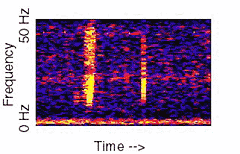
In 1997, an unusual sound was picked up
by U.S. Navy spy sensors
located deep in the Pacific Ocean. These sensors, actually a series of underwater microphones, or "hydrophones" known as SOSUS, or "Sound
Surveillance System", are actually remnants of Cold War technology that is still used today to track the movements of nuclear submarines
underwater. They are located at a level in the ocean that is particularly conducive to the transmission of sound waves, called the "deep
sound channel", wherein temperature and pressure conditions are such that sound waves are "channeled" for thousands of miles with very little
signal loss compared to other sea levels or even open air transmission. Most of these
sounds
can be traced to boats, whalesong, volcanic
activity, earthquakes, and so forth, but some have yet to be determined. One of these is the mysterious sound known only as
"Bloop".
Researchers have nicknamed the strange unidentified sound picked up by undersea microphones "Bloop." While it bears the varying frequency
hallmark of marine animals, it is far more powerful than the calls made by any creature known on Earth, Britain's
New Scientist
reported on Thursday. It is too big for a whale and one theory is that it is a deep sea monster. The
frequency of the sound meant it had to be much louder than any recognised animal noise, including that produced by the largest whales.
Scientists from the U.S.'s NOAA have been baffled by the "Bloop" sound, [but] agree that the sound is most likely to be biological in
origin.9
This sound may be the sound of something very large, very powerful, and very old awakening — bigger than anything currently known to man,
or at least not for a very long time. Could it be Leviathan awakening from his ages long sleep? Is Jormungand making ready for war? Surely
the creature making these noises could not span the entire globe as does the Midgard Serpent of Norse lore, but something very big is definitely
waiting to be discovered in the abyssal plains of the Pacific. Stay tuned to Mysterious World as the search
continues.
Mysterious Sea Serpents Part I: Nessie
|
Part II: Champ
|
Part III: Ogopogo
Editorial
|
Press Releases
|
Book Reviews
|
Fragments
Effigy Mounds II
|
Sea Serpents IV
|
Atlantis IV
Register
for our new Hall of Records Newsletter!
Questions? Comments? Suggestions? Advertising? Press Releases?
Contact us!

Yahoo! Canada Directory: Sea Serpents and Lake Monsters
Google Web Directory: Sea Serpents and Lake Monsters
Nessie's Grotto: Lake Monsters
The Aquatic Monsters Site
The Online Lake Cryptid Directory
Cryptozoo: Forum
EXN.ca: "Hunting the Elusive Sea Serpent"
Monsterwatch: Index of Lake and Sea Monsters
Cryptozoology.st
Dave's Mythical Creatures and Places: Sea Serpent
The Unnatural Museum: Sea Serpents
Strange Science: Sea Monsters
X-Project Paranormal Magazine: When Lake Monsters Attack!
KidzWorld: Lake Monsters
Wierd Wisconsin: Lake Monsters
Pararesearchers.org: Ontario's Lake Monsters
Norwegian Sea Serpents
British Columbia Scientific Cryptozoology Club: Lake Monsters of Russia
British Columbia Scientific Cryptozoology Club: Lake Monsters of Ireland
The Unnatural Museum: Sea Monsters that Weren't
The World, The Word & You!: Sea Monsters
Log Cabin Chronicles: "Unexplained Things that Swim in Water"
Tacoma Public Library: "Unsettling Events"
Surreal Seal Campaign: A web site dedicated to the possible existence of a Seal with a long neck...
Fortean Times: Fortean Gallery: Beasts: Sea Serpent
Fortean Times: Fortean Gallery: Beasts: Another Sea Serpent
Brown Marine Service, Inc.: Regional Sea Stories
Windows to the Universe: Hydra
Mystery Science Theater 3000: The Viking Women and the Sea-Serpent
Altamaha-Ha: Sea Monster Of Darien, GA
Austin Area Occult Research Archive: Altamaha-Ha
Cryptozoology.com: Altamaha-Ha
The Dixie X-Files: The Altamaha-Ha
Far Shores: "Teens Recall Georgia Monster Sighting"
McintoshCounty.com
Georgia Lakes LMER: Altamaha River
Altamaha Coastal Tours
Summit to the Sea: Darien, GA Docks and Shrimp Fleet
VisitCoastalGeorgia.com
Fort King George Historical Site
Ohio.com: "Strange Stories Ripple beneath Erie's Surface"
Monster Tracker
Monster Tracker: Lake Erie Restaurants & Lodging
Monster Tracker: Lake Erie Cruises
Creature Chronicles: "South Bay Bessie: A Monster of Lake Erie"
H2-0HIO CRYPTIDS
Lake Erie Monster?
TravelCleveland.com
Cleveland.com
Carnegie Library of Pittsburgh: Cleveland, Ohio
The Cadborosaurus Watch
CaddyScan: Search for the Cadborosaurus Willsi
The ShadowLands: Cadborosaurus
Folklore Heritage in the Pacific Northwest: The Cadboro Bay Sea Serpent
British Columbia Scientific Cryptozoology Club: Cadborosaurus
Far Shores: Interest Renewed in Canada's West Coast Water Monster
British Columbia Adventure Network
British Columbia Adventure Network: Cruising British Columbia's Vancouver Island
Vancouver Island Accomodations
The Back Roads Ghost Society: Chessie the Sea Monster
The Enigma Project: "Chessie" (The Chesapeake Bay Phenomenon)
The Dixie X-Files: "Chessie": The Sea Monster of the Chesapeake Bay
Gettysburg Ghosts: Chessie: The Chesapeake Bay Monster
USGS: Chessie Update
PrinceGeorges.com: Map of Maryland
Chesapeake Bay Gateways Network
Chesapeake Bay Program
Chesapeake Bay Program: Visit the Bay
Alliance for the Chesapeake Bay
Chesapeake Bay Foundation
Chessie Returns! (Coloring Book)
The Shadowlands: Colossal Claude
Travel Oregon Online
Oregon Attractions Guide
Go Northwest! Columbia River Gorge
USDA Forest Service: Columbia River Gorge National Scenic Area
USGS: Map of Columbia River and Tributaries
About.com: "The Columbia's Gorgeous Gorge"
Columbia River Walking Club
Columbia River Fishing
Columbia River Bridges
Waterfalls of Oregon: Columbia River Gorge
AboutVia: Historic Columbia River Highway
Bicycle Adventures Oregon Tours: Columbia Gorge
Sternwheeler Columbia Gorge & Marine Park
Adventure Cruises
Travel Books USA: America's Scenic Drives: Historic Columbia River Highway
Astoria, Oregon
OldOregon.com: Official Site for Astoria and Warrenton, Oregon
Wet Planet Rafting
Mount Hood Railroad
Mt. Hood Hamlet Bed & Breakfast
FlatheadLakeMonster.com
Flathead Lakers: Flathead Lake Monster
Far Shores: "New Web Site Tracks Flathead Lake Monster"
A Not-Quite-Official Flathead Monster Sighting Data-Collection Project
Mountain Press Publishing Company, Inc: Flathead Lake Bathymetric Map
About Montana: Montana Nessie: Legend of the Flathead Lake Monster
Montana's Flathead Valley
MontanaKids.com: Flathead Lake State Park
The Unnatural Museum: The Monstrous Sea Serpent of Gloucester
The Gloucester Sea Serpent
Out of Gloucester: Sea Serpents
World of the Strange: "The Ship 'British Banner'"
The Great Sea Serpent of 1848
Gloucester, Massachusetts: Official Site
Gloucester, Massachusetts: Ten Pound Island Light
The Sandy Hook Monster
The Serpent of Long Beach Island
Passagen: Gryttie: Monster in Gryttjen [Sweden]
The Swedish Travel and Tourism Council
Sweden.com: Travel
Lonely Planet: Sweden
WorldTravelGuide.net: Sweden
The Lake Hodges Monster
North County Times: "Hodgee, the Friendly Lake Hodges Monster: Fact or Fiction?"
Lake Hodges Aquatic Center
The City of San Diego: Hodges Reservoir
The San Dieguito River Park: Lake Hodges
San Diego Fish Online: Lake Hodges
Trails.com: Lake Hodges
San Diego Climber's Coalition: Lake Hodges Dam
EarthRenewal.org: Lake Hodges
British Columbia Scientific Cryptozoology Club: Igopogo
ParaResearchers.org: Ontario's Lake Monsters
Town of Georgina Official Website: Lake Simcoe
Lake Simcoe Region Conservation Authority
The Basilian Press: Strawberry Island in Lake Simcoe
Simcoe Fishing Adventures
FishingLakeSimcoe.com
Cruising & Boating Canada Online: Lake Simcoe
The Briars - Another World on Lake Simcoe
Cottages on the Web: Lake Simcoe Villa
Irmo, South Carolina: Loch Murray Monster
The Dixie X-Files: The Loch Murray Monster
Town of Irmo, South Carolina: Official Site
Irmo, South Carolina Chamber of Commerce
Irmo, South Carolina: Featuring Lake Murray
Discover South Carolina
LakeNormanMonster.com
Mooresville, NC Chamber of Commerce
Mooresville, NC: Official Site
Lake Norman Directory: Restaurants
Lake Norman Directory: Entertainment/Recreation
Lake Norman Directory: Lake Norman Ventures: Guided Striper Fishing Tours
Welcome to Ogopogo Country: The Lake Utopia Monster
The Online Lake Cryptid Directory: Lake Utopia
St. George, New Brunswick
Destination New Brunswick
Tourism New Brunswick, Canada
BayofFundy.com
Lake Digdeguash Four Season Chalets
CNN.com: Lake Van, Turkey Sea Monster?
CNN.com: Lake Van, Turkey: Video
Ben S. Roesch's Home Page: "Ankara hunts the 'Lake Van monster'"
Southwestern Bell World Room: Lake Van, Turkey
Earthnet Online: Lake Van, Turkey
Republic of Turkey Ministry of Culture: Van
Let's Go Turkey - Travel Guide to Turkey
International Nature & Cultural Adventures: Turkey
The World Factbook 2002: Turkey
Minnesota State University eMuseum: Lake Van
GreenTours Natural History Holidays: Lake Van
Places of Peace and Power: Akdamar Island, Lake Van, Turkey
Turkey Travel Planner: Lake Van, Turkey
Adiyaman, Turkey: Lake Van
British Columbia Scientific Cryptozoology Club: Manipogo (Lake Manitoba)
Adventure Safaris: Search for Manipogo
The Shadowlands Sea Serpent Page: Manipogo
The Online Lake Cryptid Directory: Manipogo
Travel Manitoba
Hunting and Fishing in Dauphin, Manitoba
Map of Lake Manitoba area (PDF)
Lake Manitoba Regulation Review Advisory Committee: Lake Manitoba
Lake Manitoba Regulation Review Advisory Committee: Lake Manitoba
Manitoba Conservation: Manipogo Provincial Park
Lake Manitoba Narrows Lodge
Memphre.com: The Sea Serpent of Lake Memphr�magog
Log Cabin Chronicles: The Lake Monster's Lair
Mysteries of Canada: The Creature of Lake Memphremagog
British Columbia Scientific Cryptozoology Club: Memphre (Lake Memphremagog)
ChampQuest 2000: The Monster of Lake Memphremagog
Log Cabin Chronicles: "Memphre: the Lake Monster Update'"
Log Cabin Chronicles: "Eyewitnesses say 'Memphre's back!'"
Sail Lake Memphremagog
Tourisme Memphremagog
Magog & Lake Memphremagog
Jay Peak Resort: Lake Memphremagog Cruises on the Stardust Princess
StrangeMag.com: Nahuelito, Patagonian Lake Monster
British Columbia Scientific Cryptozoology Club: Nahuelito
The Crypto Web: Living Dinosaurs
Austin Area Occult Research Archive: Nahuelito
Cryptozoologix: Nahuelito
Cryptozoology2: Nahuelito
Encyclopedia Mythica: Nahuelito
About.com: Nahuel Huapi, Argentina
TOPICS: The Incredible Nahuel Huapi National Park
NASA Earth Sciences & Image Analysis: Lake Nahuel Huapi, Southern Andes Mountains, Argentina
Argentina.com
Travel Ideas Bariloche
Travel Ideas Bariloche: Hiking in Nahuel Huapi National Park
Bariloche: Patagonian and Argentinian Travel (Spanish)
Bariloche: Lake Nahuel Huapi Live Webcam
Patagonia-Argentina.com: Lake Nahuel Huapi
Argentour.com
Argentour.com: Nahuel Huapi National Park
Argentina Discover: Bariloche and Magical Sceneries
Ladatco Tours: Bariloche, Argentina
ArgenFriends: Nahuel Huapi National Park
Dorto - Tourism in Argentina: Bariloche
LatinTrip.com: Ski Bariloche
Argenfly Fly Fishing: Lake Nahuel Huapi
The Legend of One-Eye
Lake Granbury Water Serpent Discussion Group
Lake Granbury Area Chamber of Commerce
Granbury-TX.com
The Lake Granbury Info Center
Brazos River Authority: Lake Granbury
The Captain's House on the Lake: Bed & Breakfast
The Granbury Rose: Authentic Sternwheeler
Striper Fishin'
Texas Freshwater Fishing: Lake Granbury
Superior Cryptozoic Online: Lake Superior's Pressie
Superior Cryptozoic Online: The Pressie Photo
Travel Michigan
National Geographic Travel Calendar: Hike Lake Superior
Sault Ste. Marie Travel
Sault Ste. Marie, Michigan: Official Site
Lake Superior Magazine Online
Superior Sights: Upper Peninsula of Michigan
Lake Superior Visits
Lake Superior Circle Tour
Great Lakes Information Tour: Lake Superior Circle Tour
LakeSuperiorDrive.com
American Woman Road & Travel: A Superior Lodging Experience
Bob's Cabins on Lake Superior
CNN.com: Expedition sets out to trap Norwegian 'sea monster'
CNN.com: Monster mysteries continue to baffle Europe
The Shadowlands: Selma
X-Project: Trapping Selma
Cryptozoology.st: Selma Is Scientifically Confirmed
Mjoesormen.no: Norwegian Sea Serpents
On Science: Selma
Norway.com
Frommer's: Norway
TravelToday.net: Norway
The Travel Guru: Seljord
GoThere.com: Telemark County info
Telemark County: Official Site
Telemark Tourist Information Office
NorwayLinks.net: Norway Travel Links
Multimap.com: Seljord
Europe Vacations: Grand Tour Scandinavia
Seljord Hotel
Weather in Norway
Austin Area Occult Research Archive: Slimy Slim
Payette Lake Area Map
The City of McCall, Idaho: Official Site
McCall Chamber of Commerce
Brundage Mountain Resort
HighOnAdventure.com: McCall, Idaho � Ski Town U.S.A.
Online Highways: Payette Lake
Virtual Cities: McCall Cabin at Payette Lake
SailIdaho.com: Payette Lake - McCall, Idaho
Storsjoodjuret Official Site
Strangemag.com: The Lake Storsjon Monster
LakeMonster.net: Storsjoodjuret
Monster Tracker: Storsjoodjuret
The Online Lake Cryptid Directory: Swedish Lake Monsters
Sweden.com
Jamtland County: Official Site
Jamtland County: Travel Info
Ostersund & Froson: Lake Storsjon Boat Tour
Anderson Scandinavian Tours: Land of the Midnight Sun Tour with Norwegian Coastal Voyage
The Good Life: Lake Storsjon
Tahoe Tessie's 101 Fun Things to Do in Lake Tahoe: The Dragon's Pearl
Tahoe Tessie's 101 Fun Things to Do in Lake Tahoe
Lake Tahoe Ghost Hunters
Tahoe.com
Virtual Tahoe: A Directory Guide to Lake Tahoe South Shore
Virtual Tahoe: A Directory Guide to Lake Tahoe South Shore
All About Reno/Lake Tahoe
Tanager Realty: Lake Tahoe Facts and Figures
Lake Tahoe Cruises
Lake Tahoe: Where to Eat and Stay
Lake Tahoe Summer Music Festival
Tahoe Family Encampment
Ve�sta, the Monster of Chesil Beach
Mapquest: Map of Chesil Beach
Britain Express: Chesil Beach
Chesil Beach Holidays
BootsnAll.com: "Chesil Beach and the Ancient Mermaid"
SportExtreme.com/Diving: Chesil Beach
DiveDorset.com: Chesil Beach Diving
Wykenet The Internet Site of the Village of Wyke Regis, Dorset, England
Southwest Coast Path: Chesil Beach, Dorset
Chesil Beach Fishing
Hensleigh Hotel Chesil Beach
Chesil Beach Holiday Village
Chesil Beach Holiday Park
West Dorset Links
About.com: The Ghosts of Arkansas: The White River Monster
The Unnatural Museum: The Misplaced Monster of the White River
The Crypto Web: White River Monster
White River Monster Investigation
Ozark Gateway Region: Jackson County
Hotel Fun for Kids: Legendary Arkansas Monsters

 The Great New England Sea Serpent: An Account of Unknown Creatures Sighted by Many Respectable Persons Between 1638 and the Present Day
J. P. O'Neill
Rating:
June O'Neill has pulled off the very difficult feat of writing a book on a cryptozoological subject and making that book balanced, readable, and highly entertaining. This thoroughly researched examination of the New England "sea serpent" story - not just the celebrated events of 1817, but all sightings, from Colonial times through the present day - is enough to make even the most hardened skeptic gaze out to sea and ponder whether we may have overlooked a spectacular discovery. O'Neill doesn't try to argue the case for a large, unknown animal. She lets the witnesses speak for her and lets the reader draw the conclusions. Bottom line: This is a marvelous book. No one with an interest in marine life, cryptozoology, or the magic and mystery of the oceans should pass it by.
(Review by Amazon.com)
Click
here
to buy this book.
 Atlas of the Mysterious in North America
Rosemary Ellen Guiley
Rating:
This atlas locates and gives brief descriptions of the most intriguing places in the United States and Canada. Burial mounds, sacred places, ghost lights, haunted spots and even the locations of cryptozoological sightings are covered. Find out if your state is home to a mystery, or peruse the atlas to get ideas about where to go for your next vacation.
(Review by Amazon.com)
Click
here
to buy this book.
The Story of Tahoe Tessie: The Original Lake Tahoe Monster
Bob McCormick, Eileen Lambert (Illustrator)
Click
here
to buy this book.
 Devil's Ditch: Ol' Whitey and the Shivaree
Fletcher McGhee
Epic and factual tale of the New Madrid earthquake of 1811-12 and the frequently reported sightings of the White River Monster.
Click
here
to buy this book.
 The Book of Sea Monsters
Bob Eggleston and Nigel Suckling
Rating:
For millennia, humankind has been fascinated by the awesome power of the sea and the creatures sheltered by its depths.
In the past, ocean crossings toward new horizons were not just challenges of the physical elements, but defiances of the perils
which the human imagination projects onto the unknown. Now, in The Book of Sea Monsters, these mythical creatures of the
deep are vividly brought to life by award-winning artist Bob Eggleton. Exploring the myth, legend, scientific documentation and
fiction inspired by the creatures like the serpent of Midgard, the biblical Leviathan, the Kraken and the infamous monster of
Loch Ness, The Book of Sea Monsters will thrill and fascinate all lovers of mythology, legend and the many secrets of the sea.
(From the back cover)
Click
here
to buy this book.
 The Lost World
Arthur Conan Doyle, Michael Crichton (Introduction)
Rating:
Forget the Michael Crichton book (and Spielberg movie) that copied the title. This is the original: the terror-adventure tale of
The Lost World. Writing not long after dinosaurs first invaded the popular imagination, Sir Arthur Conan Doyle spins a yarn about
an expedition of two scientists, a big-game hunter, and a journalist (the narrator) to a volcanic plateau high over the vast
Amazon rain forest. The bickering of the professors (a type Doyle knew well from his medical training) serves as witty contrast
to the wonders of flora and fauna they encounter, building toward a dramatic moonlit chase scene with a Tyrannosaurus Rex.
And the character of Professor George E. Challenger is second only to Sherlock Holmes in the outrageous force of his personality:
he's a big man with an even bigger ego, and if you can grit your teeth through his racist behavior toward Native Americans,
he's a lot of fun.
(Review by Amazon.com)
Click
here
to buy this book.
 The Loch Ness Monster: The Evidence
Steuart Campbell
Rating:
Does an ancient monster still lurk in the depths of Scotland's Loch Ness and what secrets may the mysterious loch hold? Scottish science writer Steuart Campbell surveys the eyewitness evidence, reviews the most notorious reports, exposes the falsehoods behind each alleged sighting, and much more in this definitive work on the subject. Photos .
(Review by Amazon.com)
Click
here
to buy this book.
 Monsters of the Sea: The Truth About the Loch Ness Monster, the Giant Squid, Sea Serpents, Mermaids, and Other Fantastic Creatures of the Deep
Richard Ellis
In Monsters of the Sea, Richard Ellis, one of the country's foremost authorities on ocean life, casts his net wide in search of the most unusual aquatic creatures - from mermaids to manatees to the Loch Ness monster and the mythical sea serpent for whom the giant squid has frequently been mistaken. He examines the literary sources of sea-monster lore, from The Odyssey to Jules Verne to Peter Benchley.
Highly entertaining, packed with curiosities, and backed by the author's impeccable scientific credentials, Monsters of the Sea is a one-of-a-kind journey into two extremely fertile worlds: the human imagination and the deep blue sea.
(Review by Amazon.com)
Click
here
to buy this book.
 Mysteries of the Deep
Frank Spaeth (Editor)
If you're thinking of going deep sea fishing, you'll think again after you read MYSTERIES OF THE DEEP, a compilation of the best sea stories from the past 47 years of FATE magazine. From Atlantis to the Bermuda Triangle, from the Loch Ness Monster to giant jellyfish, you'll find more than a few reasons to stay out of the water. These reports come from the personal experiences of average citizens as well as detailed investigations of well-known authors.
(Review by Amazon.com)
Click
here
to buy this book.
More Sea Serpent books...


 Loch Ness Monster
Size: 34 in x 24 in
Rating:
The original and still the best. The classic "Surgeon's Photo" has since been debunked as a clever hoax, but it still remains as a cryptozoological classic. (Review by Mysterious World)
Click
here
to buy this poster.
Editorial
|
Press Releases
|
Book Reviews
|
Fragments
Effigy Mounds II
|
Sea Serpents IV
|
Atlantis IV
Register
for our new Hall of Records Newsletter!
Questions? Comments? Suggestions? Advertising? Press Releases?
Contact us!
|