
Editorial
|
Press Releases
|
Book Reviews
|
Fragments
NEW! Artifacts: Coral Castle
Grand Canyon II
|
Giants IV
|
Osiria IV
Register
for our Hall of Records Newsletter!
Questions? Comments? Suggestions? Advertising? Press Releases?
Contact us!
The Grand Canyon Part I: Postcards from the Edge
NEW!
Grand Canyon Discussion Board
(Requires Registration)
The Hopi Cosmology
|
The Place of Emergence
|
The Hollow Earth
The Lost City of the Dead
|
Koyaanisqatsi
|
Grand Canyon Links
|
Grand Canyon Books
Grand Canyon Audio
|
Grand Canyon Video

|
|
|
|
|
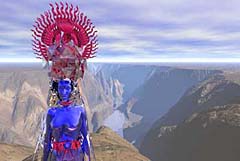
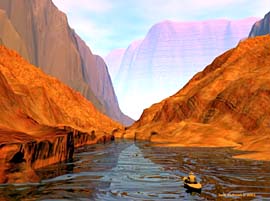
Jack Andrews' digital interpretation of G. E. Kinkaid's infamous 1908 expedition down the Colorado River, wherein he claimed to have found
a cave filled with fabulous treasures from a forgotten period of North America's ancient history. The Hopi and their ancestors, the Anasazi,
believed that their ancestors had hidden in a cave from
the Great Flood,
emerging afterwards to repopulate the world.
Image © 2001, Jack Andrews, from
Lost City of the Dead in the Grand Canyon.
|
 hough most people think of the Grand Canyon as a fairly pedestrian tourist destination, most do not know of the many mysteries associated with the Canyon and its environs. As sacred as the Canyon is to the American tourism industry, the place that the canyon holds in the hearts and minds of the native peoples of the region is far greater.
In the worldview of the native Americans of the Desert Southwest, the Canyon is a great and important sacred space that occupies a central place in native cosmologies throughout the region. Wallace explains,
hough most people think of the Grand Canyon as a fairly pedestrian tourist destination, most do not know of the many mysteries associated with the Canyon and its environs. As sacred as the Canyon is to the American tourism industry, the place that the canyon holds in the hearts and minds of the native peoples of the region is far greater.
In the worldview of the native Americans of the Desert Southwest, the Canyon is a great and important sacred space that occupies a central place in native cosmologies throughout the region. Wallace explains,
Long before geologists arrived in the Grand Canyon to examine its rocks and deduce its origins, the Indians who lived around the Canyon had created their own explanations for the formation of the spectacular chasm. These ideas, passed down from generation to generation by tribal medicine men and storytellers, were expressed as poetic myths.... The Canyon myths are part of broad cosmologies that enabled the Indians to cope with a harsh and unpredictable environment making comprehensible the forces that surrounded their unique world. To the Ute and the Southern Paiute, the Hualapai and Havasupai, the Hopi and the Navajo, that world and those forces were inextricably joined. Rocks were not simply rocks; they were supernatural beings,
watching over the tribesmen and guarding their collective destiny. Water, in this water-starved land, had a life of its own. The great river that formed the Canyon gorge led to the Indians' promised land, and springs had souls, to be placated by offerings of peaches, corn and tobacco. The animals that the Indian hunted, the spiders that inhabited his dwelling, the snakes that slithered across his trail, all were his equals — sometimes his heroes and sometimes his spiritual mentors.1
The same awe that fills visitors today was the inspiration for native Americans to make the Grand Canyon the focal point of their myths and legends. Some native tribes believe that the Canyon was the result of the Great Flood that had drowned the previous, wicked world that had forgotten the gods, having turned their minds away from natural things and towards metal and wheels — means through which they could conquer and enslave their fellow men. And of all of the local cosmologies the most famous and oft-quoted is that of the Anasazi, and their modern-day descendants, the Hopi.

|
|
|
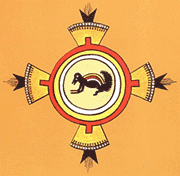
The Hopi "sun symbol", a symbol that was common throughout the ancient Americas. Each of the four rays also symbolizes each of the four "worlds"
of the Hopi, ages of the world that have been punctuated by global disasters that had destroyed the civilizations of the previous ages. The most
recent disaster, according to the Hopi cosmology, was that of a global flood, which the Hopi had escaped by following a "star" to an underground
cave where they waited for the Flood to subside,
emerging afterwards to repopulate the world. The sun symbol was a variation of the swastika which,
as we have seen,
originated from Central Asia somewhere between 5000-2000 b.c. The Hopi believe that we are now living at the end of the fourth and final age.
Image from
Book of the Hopi.
|
|
The Hopi cosmology is particularly clear on this point, that the ancient world was destroyed not once, but three times, most recently by a flood. The Hopi also believe that the Grand Canyon was the Sipapu, the "place of emergence" from whence the Hopi had emerged after the Great Flood had destroyed the third "world" of mankind that had preceded the current, or "fourth" world.
The Hopi believed that they had been chosen by the gods to survive the flood and repopulate the world. In fact, their religious text,
The Book of the Hopi,
is strikingly similar to the Hebrew Bible in its understanding not only of the Great Flood, but of the Creation itself. Like the Hebrew cosmology, the Hopi cosmology includes a Father God who is infinite and perfect. And like the Christian cosmology, the Father God manifested a "son" — or, in this case, a "nephew" — whom he used to create the universe.
The first world was Tokpela [Endless Space]. But first, they say, there was only the Creator, Taiowa. All else was endless space. There was no beginning and no end, no time, no shape, no life. Just an immeasurable void that had its beginning and end, time, shape, and life in the mind of Taiowa the Creator. Then he, the infinite, conceived the finite. First he created Sotuknang to make it manifest, saying to him, "I have created you, the first power and instrument as a person, to carry out my plan for life in endless space. I am your Uncle. You are my Nephew. Go now and lay out these universes in proper order so they may work harmoniously with one another according to my plan." Sotuknang did as he was commanded. From endless space he gathered that which was to manifested as solid substance, molded it into forms, and arranged them into nine universal kingdoms [planets?]: one for Taiowa, the Creator, one for himself, and seven universes for the life to come. Finishing this, Sotuknang went to Taiowa and asked, "Is this according to your plan?" "It is very good," said Taiowa. "Now I want you to do the same thing with the waters. Place them on the surfaces of these universes so they will be divided equally among all and each." So Sotuknang gathered from endless space that which was to be manifest as the waters and placed them on the universes so that each would be half solid and half water. Going now to Taiowa, he said, "I want you to see the work I have done and if it pleases you." "It is very good", said Taiowa. "The next thing now is to put the forces of air into peaceful movement about all." This Sotuknang did. From endless space he gathered that which was to be manifest as the airs, made them into great forces, and arranged them into gentle ordered movements around each universe. Taiowa was pleased. "You have done a great work according to my plan, Nephew. You have created the universes and made them manifest in solids, waters, and winds, and put them in their proper places. But your work is not yet finished. Now you must create life and its movement to complete the four parts, Tuwaqachi, of my universal plan.2
Father Taiowa had created and ordered the universe through his son, Sotuknang, creating Earth's atmosphere, dividing the waters above from the waters below, all strikingly similar to the Hebrew creation story in
Genesis 1.
This was "Tokpela", the First World.
In order to help him carry out Taiowa's orders to "create life and its movement to complete the four parts of Taiowa's universal plan" — the four "Worlds", or ages of mankind — Sotuknang decided to create a helper whom he named Kokyangwuti, or "Spider Woman".
|
|
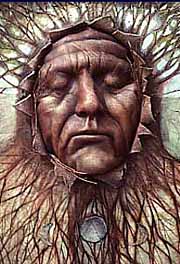
"Spider Grandmother". The Spider Woman myth is common through the beliefs of the Native Americans of the American Southwest. It is believed that
all life on earth, including plant, animal, and human life, was created by Spider Woman, who had been delegated that task by the gods at the very
beginning of Earth's history. Even today, they believe, she sits at the center of the universe, acting as the great female force of the primeval
creation that binds together all nations, tribes and families in her web of influence, keeping the forces of nature in balance.
Image: "Ancestral Shield" by Lauren Raine, MFA.
www.rainewalker.com.
|
|
Sotuknang went to the universe wherein was that to be Tokpela, the First World, and out of it he created here who was to remain on that earth and be his helper. Her name was Kokyangwuti, Spider Woman. When she awoke to life and received her name, she asked, "Why am I here?" "Look about you," answered Sotuknang. "Here is this earth we have created. It has shape and substance, direction and time, a beginning and an end. But there is no life upon it. We see no joyful movement. We hear no joyful sound. What is life without sound and movement? So you have been given the power to help us create this life. You have been given the knowledge, wisdom, and love to bless all the beings you create. That is why you are here." Following his instructions, Spider Woman took some earth, mixed with it some tuchvala (liquid from mouth; saliva), and molded it into two beings. Then she covered them with a cape made of white substance which was the creative wisdom itself, and sang the Creation Song over them. When she uncovered them the two beings, twins, sat up and asked, "Who are we? Why are we here?" To the one on the right Spider Woman said, "You are Poqanghoya and you are to help keep this world in order when life is put upon it. Go now around all the world and put your hands upon the earth so that it will become fully solidified. This is your duty." Spider Woman then said to the twin on the left, "You are Palongawhoya and you are to help keep this world in order when life is put upon it. This is your duty now: go about all the world and send out sound so that it may be heard throughout all the land. When this is heard you will also be known as 'Echo', for all sound echoes the Creator".... When they had accomplished their duties, Poqanghoya was sent to the north pole of the world axis and Palongawhoya to the south pole, where they were jointly commanded to keep the world properly rotating.... "These will be your duties in time to come", said Spider Woman. She then created from the earth trees, bushes, plants, flowers, all kinds of seed-bearers and nut-bearers to clothe the earth, giving to each a life and name. In the same manner she created all kinds of birds and animals — molding them out of earth, covering them with her white-substance cape, and singing over them. Some she placed to her right, some to her left, others before and behind her, indicating how they should spread to all four corners of the earth to live.3
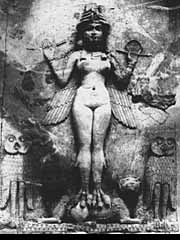
The demoness Lilith of ancient Hebrew legend. This image, called
"The Burney Relief",
shows a winged woman with owl feet, flanked by owls, and standing on two lions. Lilith is the "She Demon" of ancient
Babylonian, Sumerian, Hebrew, and rabbinical myth. She is written of in
Isaiah 34:14
as a "screech owl," and is a form of apocalyptic harbinger. Lilith may have a ready cognate in the "Spider Woman" of Hopi mythology, as she is
also believed to have had a role in the creation of mankind.
|
|
After having directed Spider Woman to create plants and animals, Sotuknang then directed her to create mankind as the crowning glory of the Creation.
Much like the
Lilith
of the Hebrew legends, the Spider Woman is believed to have been actively involved in the creation of living things, including mankind, God apparently having delegated the specifics of that work to lesser spirits such as Spider Woman/Lilith to carry out. This may explain the usage of the plural name of God elohim in Genesis — the writer wanted to emphasize that God had delegated the detail work to lesser spirits in the divine assembly:
"So Spider Woman gathered earth, this time of four colors, yellow, red, white, and black; mixed with tuchvala, the liquid of her mouth; molded them; and covered them with her white-substance cape which was the creative wisdom itself. As before, she sang over them the Creation Song, and when she uncovered them these forms were human beings in the image of Sotuknang. Then she created four other beings after her own form. They were wuti, female partners, for the first four male beings."4
Just as in the Bible, Adam was created in the image of God, so in the Hopi myths man was created in the image of Sotuknang. Interestingly, in the Hopi account, women were not created in the image of God, but of Spider Woman. Moroever, in the Hopi account, four great races were created at the beginning, instead of just one, which would have provided a greater genetic variation that would have been necessary for humanity to allow for long term genetic health. The Hopi version of the creation of man also sounds much like the Mesopotamian myth of the creation of man, where a goddess named "Nintu" broke off 14 pieces of primordial clay, using them to create seven male and seven female embryos which then grew to become the first men and women that formed the beginnings of mankind. Seven pairs of males and females would provide an even better genetic selection which would further guard against inbreeding, though at least 40-50 male-female pairs would be much more advisable, unless there are some other natural (or supernatural) mechanisms at work that we are not aware of.
Though Nintu was able to create the men and women, she was not able to give them life. Instead, one of the gods had to be sacrificed and his blood used to give them life.5
Similarly, the one thing that Spider Woman was not able to give mankind was intelligence — the ability to speak, move, and act intelligently. She then called upon Sotuknang, who came and gave each of the four races of mankind their own language, the power to reproduce and multiply, and the wisdom to respect the differences between them. And for this, all Sotuknang asked is that they respect the Creator at all times. "Wisdom, harmony, and respect for the love of the Creator who made you. May it grow and never be forgotten among you as long as you live."6

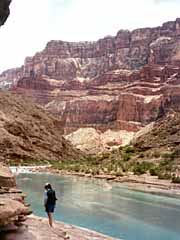
|
Morning at Nankoweap, a passage along the Little Colorado River. The Hopi still visit this area for pilgrimages and to search for salt to use in
religious ceremonies. Though rafters and kayakers frequent the area, the ritual areas are strictly off limits.
Tokpela, the "First World", was likely open and wild like the canyon, which is likely part of the attraction and fascination it holds for the
Hopi.
Image from
Kayak Place.
|
|
Tokpela ("Endless Space") the First World, was as pure and perfect as a finite world can be, and the hearts of the people were as one. Their bodies were perfectly in tune with both Taiowa the Creator and the Earth, from which their bodies had been formed. They formed a perfect union between heaven and Earth, which is the purpose for which they had been created.
Thus the First People understood themselves. And this was the First World they lived upon. Its name was Tokpela, Endless Space. Its direction was west; its color sikyangpu, yellow; its mineral sikyasvu, gold. Significant upon it were katoya, the snake with the big head; wisoko, the fat-eating bird; and muha, the little four-leaved plant. On it the First People were pure and happy. So, the First People kept multiplying and spreading over the face of the land and were happy. Although they were of different colors and spoke different languages, they felt as one and understood one another without talking. It was the same with the birds and animals. They all suckled at the breast of their Mother Earth, who gave them her milk of grass, seeds, fruit, and corn, and they all felt as one, people and animals.7
However, the paradise of Tokpela was not to last forever. As in the Hebrew account, so in the Hopi account there was a serpent that entered paradise and began to confuse the people with words and turn them away from Taiowa, the Creator:
But gradually there were those who forgot the commands of Sotuknang and the Spider Woman to respect their Creator. More and more they used the vibratory centers of their bodies solely for earthly purposes, forgetting that their primary purpose was to carry out the plan of Creation. There then came along Lavaihoya, the Talker. He came in the form of a bird called Mochni [bird like a mocking bird], and the more he kept talking the more he convinced them of the differences between them: the difference between people and animals, and the differences between the people themselves by reason of the colors of their skins, their speech, and belief in the plan of the Creator. It was then that animals began to draw away from people.... In the same way, people began to divide and draw away from one another — those of different races and languages, then those who remembered the plan of Creation and those who did not. There came among them a handsome one, Kato'ya, in the form of a snake with a big head. He led the people still farther away from one another and their pristine wisdom. They became suspicious of one another and accused one another wrongfully until they became fierce and warlike and began to fight one another. All the time Mochni kept talking and Kato'ya became more beguiling. There was no rest, no peace.8
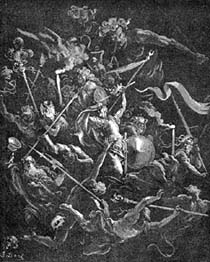
|
|
Both the Hopi traditions and the Genesis account state the the world before the Flood was in the middle of a war so total that mankind was
nearly destroyed because of it. Moreover, in both accounts, man was saved from destruction by the Creator God, so that he could repopulate the
Earth after the warlike humans who were no longer listening to Him had been wiped out.
Image from
Dore's Illustrations for "Paradise Lost".
|
Just as it was in
the world before the Flood
according to the biblical account, so it was in the First World of the Hopi that a serpent (and other creatures) came among them and beguiled mankind into following after their own selfish desires. As a result, instead of leading the simple, spiritual, unselfish lifestyle that Taiowa the Creator, Sotuknang and Spider Woman had ordained for them, they became divisive and fractious, dividing up into factions based upon the color of their skin, their languages, and other superficial differences. Even the ones who had remained loyal to Taiowa the Creator had divided up along theological lines, straining at the letter of the Law and forgetting the Spirit. Before the serpent came, it had been all about "we", but afterwards, and ever since, it has been all about "me".
As a result of this degeneration, the whole world was at war, exactly the opposite of what Taiowa the Creator had intended. So, Taiowa decided that it was necessary to destroy the world in order to save it. Fortunately for mankind, there had been some that still sang the song of Creation, and had not lost their spiritual connection with the Creator. For this reason, Taiowa, like the Hebrew Creator God, decided to save a remnant of humanity from the coming destruction.
But among all the people of different races and languages there were a few in every group who still lived by the laws of Creation. To them came Sotuknang. He came with the sound as of a mighty wind and suddenly appeared before them. He said, "I have observed this state of affairs. It is not good. It is so bad I talked with my Uncle, Taiowa, about it. We have decided this world must be destroyed and another one created so you people can start over again. You are the ones we have chosen." They listened carefully to their instructions. Said Sotuknang, "You will go to a certain place. Your kopavi [vibratory center on the top of the head] will lead you. This inner wisdom will give you the sight to see a certain cloud, which you will follow by day, and a certain star, which you will follow by night. Take nothing with you. Your journey will not end until the cloud stops and the star stops". So all over the world these chosen people suddenly disappeared from their homes and people and began following the cloud by day and the star by night. Many other people asked them where they were going and, when they were told, laughed at them. "We don't see any cloud or star either!" they said. This was because they had lost the inner vision of the kopavi on the crown of their head; the door was closed to them. Still there were a very few who went along anyway because they believed the people who did see the cloud and the star. This was all right.9
Just like the Star of Bethlehem event in Matthew 2 and the "cloudy pillar" that led the Israelites out of Egypt, so too the chosen people of Taiowa followed a cloud and a star, that appear to be one and the same. These were to be the people that were saved from the destruction of Tokpela, the First World.
When the last ones arrived Sotuknang appeared. "Well, you are all here, you people I have chosen to save from the destruction of this world. Now come with me." He led them to a big mound where the Ant People lived, stamped on the roof, and commanded the Ant People to open up their home. When an opening was made on top of the anthill, Sotuknang said to the people, "Now you will enter this Ant kiva, where you will be safe when I destroy the world. While you are here I want you to learn a lesson from these Ant People. They are industrious. They gather food in the summer for the winter. They keep cool when it is hot and warm when it is cool. They live peacefully with one another. They obey the plan of Creation." So the people went down to live with the Ant People. When they were all safe and settled Taiowa commanded Sotuknang to destroy the world. Sotuknang destroyed it by fire because the Fire Clan had been its leaders He rained fire upon it. He opened up the volcanoes. Fire came from above and below and all around until the Earth, the waters, the air, all was one element, fire, and there was nothing left except the people safe inside the womb of the Earth. This was the end of Tokpela, the First World.10

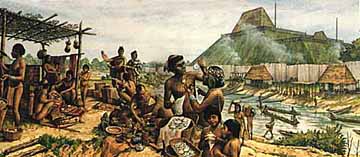
|
"Everywhere there are people carrying burdens; cultivating gardens; preparing meals; striking
a bargain for some goods from far away; conducting ceremonial dances; playing games with
either sacred or gambling intent, or both; and, in short, living their daily lives in the
metropolis." The
Cahokian
level of civilization might be a good example of the level of sophistication that the people of Topka, the Second World, attained.
Image from
Cahokia: City of the Sun
|
|
Tokpa ("Dark Midnight"), the Second World, had been created from a world purified by fire, so it was effectively as good as new. The chosen people had lived with the Ant People, eating their stored food and learning their industrious, efficient ways until the Earth had cooled sufficiently to reinhabit. Interestingly, Sotuknang instructed the chosen people to use ants as an example of industriousness and efficient living, instructing them to "consider the ant", and study its efficient lifeways, just as King Solomon would do much later in his proverbs (Prov. 6:6-8).
During this time, while the people were living with the ants and learning their ways, Sotuknang purified Earth and changed its form completely, putting land where the water had been and water where the land had been, so the wicked world that was would not be remembered in any way. After he had completed his task, Sotuknang stamped on the roof of the Ant kiva again, and let the people know that is was safe to come out.
|
|
|
|
|
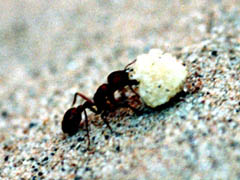
A "fire ant" native to the Grand Canyon. According to Hopi myths, the "Ant People" were allowed by Sotuknang to live on the surface of the
Earth as ants, but retreated underground when floods came, just as ants do today.
Image ©
Rhett A. Butler.
|
Sotuknang spoke first to the Ant People. "I am thanking you for doing your part in helping to save these people. It will always be remembered, this you have done. The time will come when another world will be destroyed; and when wicked people know their last day on Earth has come, they will sit by an anthill and cry for the ants to save them. Now, having fulfilled your duty, you may go forth to this Second World I have created and take your place as ants." Then Sotuknang said to the people, "Make your Emergence now to this Second World I have created. It is not quite so beautiful as the First World, but it is beautiful just the same. You will like it. So multiply and be happy. But remember your Creator and the laws he gave you. When I hear you singing joyful praises to him I will know you are my children, and you will be close to me in your hearts." So the people emerged to the Second World. Its name was Tokpa (Dark Midnight). Its direction was south, its color blue, its mineral qochasiva, silver. Chiefs upon it were salavi, the spruce; kwahu, the eagle; and kolichiyaw, the skunk.
11
The people emerged from the Ant kiva and then spread out across the face of the Earth, in all four directions, all the way to the other side of the world. However, though they were able to still communicate with each other telepathically, as they had been able to do in the First World, they still were separated from the animals. Their original close communion with nature had been shattered forever by their "original sin", never to return. Thus, instead of living off the land and being at one with nature like the animals, the people of the Second World built homes, and villages with trails between them. They created objects of both beauty and utility, and traded them with one another, all the while singing praises to the Creator, Taiowa. However, once again, all was not perfect in paradise:

|
The world axis, the two poles, and the precessional path in which the poles travel over time. The Hopi believed that the twin guardians
of the world who kept the poles from moving, Poqanghoya and Palongawhoya, had actually stepped aside from their duties temporarily at Spider
Woman's command, allowing the Earth to roll over twice at the end of the Second Age, causing the entire world to be flooded, and then frozen for
many generations, possibly centuries.
Image from
W.B. Yeats and a Vision: Astronomy.
|
|
Everything they needed was on this Second World, but they began to want more. More and more they traded for things they didn't need, and the more goods they got, the more they wanted. This was very serious. For they did not realize they were drawing away, step by step, from the good life given them. They just forgot to sing joyful praises to the Creator and soon began to sing praises for the goods they bartered and stored. Before long it happened as it had to happen. The people began to quarrel and fight, and then wars between villages began. Still there were a few people in every village who sang the song of their Creation. But the wicked people laughed at them until they could sing it only in their hearts. Even so, Sotuknang heard it through their centers and the centers of the Earth. Suddenly one day he appeared before them. "Spider Woman tells me your thread is running out on this world", he said. "That is too bad. The Spider Clan was your leader, and you were making good progress until this state of affairs began. Now my Uncle, Taiowa, and I have decided we must do something about it. We are going to destroy this Second World just as soon as we put you people who still have the song in your hearts in a safe place." So again, as on the First World, Sotuknang called on the Ant People to open up their underground world for the chosen people. When they were safely underground, Sotuknang commanded the twins, Poqanghoya and Palongawhoya, to leave their posts at the north and south ends of the world's axis, where they were stationed to keep the earth properly rotating. The twins had hardly abandoned their stations when the world, with no one to control it, teetered off balance, spun around crazily, then rolled over twice. Mountains plunged into seas with a great splash, seas and lakes sloshed over the land; and as the world spun through cold and lifeless space it froze into solid ice. This was the end of Tokpa, the Second World.12


|
|
"Turquoise Is a Girl's Best Friend". The "Wicked Woman" of Kuskurza almost single-handedly brought down the Third Age through her wickedness,
leading men into wasting their lives and fortunes by throwing them after an unattainable ideal, which led inevitably to wars of annihilation.
This character has clear parallels in today's society, and study of this motif may lend insight into the "Whore of Babylon" mentioned in
Revelation 17-18.
|
|
Kuskurza (meaning unknown), the Third World, unlike the Second World, had been born not out of fire, but out of ice. After it had been knocked off of its axis, the entire Earth had apparently become completely frozen. After a time, however, Sotuknang ordered the twins, Poqanghoya and Palongawhoya, back to their positions at the north and south poles, and the Earth began to thaw out again as its axis returned to its former station. As with the Second World, Sotuknang again set about rearranging the land and the oceans so that the previous world would not be remembered at all. He also created new mountains and rivers, and restored the plant and animal life. Once everything was complete and ready for the chosen people to inhabit, Sotuknang once again stamped on the door of the Ant kiva and called the people out. He then made it clear to them that if they wished to avoid another such catastrophe, they would have to perenially sing praises to the Creator from the tops of the hills — and if they ever did stop singing, he would know that they had returned once again to wickedness and the world would once again be destroyed.
So the people climbed up the ladder from the Ant kiva, making their Emergence to the Third World. Its name was Kuskurza, its direction east, its color red. Chiefs upon it were the mineral palasiva (copper); the plant piva, tobacco; the bird angwusi, crow; and the animal choovio, antelope. Upon it once more the people spread out, multiplied in their progress on the Road of Life. In the First World they had lived simply with the animals. In the Second World they had developed handicrafts, homes, and villages. Now in the Third World they multiplied in such numbers and advanced so rapidly that they created big cities, countries, a whole civilization. This made it difficult for them to conform to the plan of Creation and to sing praises to Taiowa and Sotuknang. More and more of them became wholly occupied with their own earthly plans. Some of them, of course, retained the wisdom granted them upon their Emergence. With this wisdom they understood that the farther they proceeded on the Road of Life and the more they developed, the harder it was. That was why their world was destroyed every so often to give them a fresh start. They were especially concerned because so many people were using their reproductive power in wicked ways. There was one woman who was becoming known throughout the world for her wickedness in corrupting so many people. She even boasted that so many men were giving her turquoise necklaces for her favors she could wind them around a ladder that reached to the end of the world's axis. 13
Though the Second World became corrupt much more quickly than the First World had, the Third World accelerated towards decline even more rapidly than the second had. Not content with simple villages, the peoples of the Third World had built vast, glittering cities of light that were highly centralized. This was not in conformity with the plans of Taiowa the Creator, who had intended man from the beginning to spread out and live close to the land, which man had indeed originally done in the First World, and had done to a limited extent in the second. In addition, the peoples of the Third World used their sexual powers not for reproduction, but for recreation, making sexual sport with each other to the point where a great prostitute was able to boast about how many men she was able to wrap around her finger. This material girl of the ancient world led mankind down the path of destruction, towards a terrific imbalance that led to a terrible world war.
|
|
|
|
|
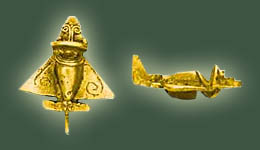
This small gold "airplane" was found in a tomb in Colombia and dismissed as "zoomorphic" — i.e., "animal-shaped". However, even a
cursory examination will reveal that this is clearly a depiction of an airplane, complete with delta wings, tail fins, and a rudder, none of
which are found in the animal kingdom. Early airplanes were essentially fabric stretched over wooden "shields" (wings). The fact that the Book
of the Hopi comes from a tradition dating back thousands of years before the modern invention of the airplane makes it clear that,
once again, there is nothing new under the sun.
Image from
Anomalies & Enigmas.
|
So the people with wisdom sang louder and longer their praises to the Creator from the tops of their hills. The other people hardly heard them. Under the leadership of the Bow Clan they began to use their creative power in another evil and destructive way. Perhaps this was caused by that wicked woman. But some of them made a patuwvota [shield made of hide] and with their creative power made it fly through the air. On this many of the people flew to a big city, attacked it, and returned so fast no one knew where they came from. Soon the people of many cities and countries were making patuwvotas and flying on them to attack one another. So corruption and war came to the Third World as it had to the others.14
This time the Earth had become corrupt much more quickly, and mankind had become cleanly divided between those who still remembered the song of Creation, and those who had forgotten it. During the First and Second Worlds, the corruption had apparently come more slowly, and the chosen people had time to be evacuated before their thread had run out. During the Third World, however, the corruption had happened so quickly and had become so intense that there was a danger that the chosen people could become corrupted before they could be evacuated to the Ant kivas again. So, this time Sotuknang told Spider Woman to not wait until their thread ran out, but to immediately create for the chosen people a means of escaping the Great Flood that Sotuknang planned to use to destroy the wicked Third World. Spider Woman then quickly cut down huge, hollow reeds and sealed the people in with white cornmeal dough to eat. Immediately afterwards, waves higher than mountains rolled in upon the land, continents broke apart and sank beneath the waves, and great rains fell, working together to drown the entire wicked Third World, Kuskurza.

|
|
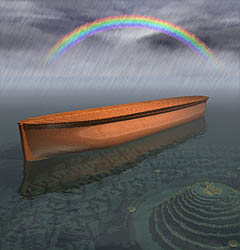
The Hopi belief of the transition from the Third World to the Fourth World, like that described in Genesis, involved a global flood, where
boat(s) were specially fashioned in order to save a remnant in order to repopulate the New World. This adds the Hopi myths to the long list of
world mythologies that support the biblical account of the Flood.
|
|
Tuwaqachi ("World Complete"), the Fourth World, was born out of water, and is the same world we live in today. After having endured the buffeting of the waves, the chosen people found their reeds had washed upon onto the top of one of the highest mountains. From there, they could see no land — the entire world had been drowned. Like Noah, they sent different kinds of birds to see if they could find any land, but all returned without having found any. Sotuknang then came to Spider Woman and said that they must stop thinking with human knowledge, but instead open their minds to the inner wisdom that hears the words of the Creator that constantly speak throughout the Earth. Trusting themselves to the inner wisdom and the will of the Creator, they created rafts and allowed the wind and the water to carry them where they were meant to go.
They found several islands, many of them beautiful and full of good food to eat, but none of those islands was the Fourth World they had been promised. Spider Woman reminded them that if they stayed on one of these pleasant islands, they would become decadent and fight among themselves again, as had the people of the previous three worlds. The Fourth World was meant to be harder to live on than the previous three worlds, so as to help mitigate against that tendency. Instead of relying on human skill, they were to rely on the inner wisdom to which the needs of the body must take second place, so that they would not fall again into sin as had the previous three worlds. This was part of the Walk of Life, of Taiowa's plan, which the material world had a tendency to obscure. People who forgot about the Plan got too involved in earthly cares, and this is what brought about the previous three destructions. So, following the inner wisdom, they finally stopped trying to find their Place of Emergence, and instead let the inner wisdom guide them to it.
Not knowing what to do, the people stopped paddling, opened the doors on top of their heads, and let themselves be guided. Almost immediately the water smoothed out, and they felt their rafts caught up in a gentle current. Before long they landed and joyfully jumped out upon a sandy shore. "The Fourth World!" they cried. "We have reached our Place of Emergence at last!" Soon all the others arrived and when they were gathered together Sotuknang appeared before them. "Well, I see you are all here. That is good. This is the place I have prepared for you. Look now at the way you have come." Looking to the west and the south, the people could see sticking out of the water the islands upon which they had rested. "They are the footprints of your journey", continued Sotuknang, "the tops of the high mountains of the Third World, which I destroyed. Now watch." As the people watched them, the closest one sank under the water, then the next, until all were gone, and they could see only water. "See, I have washed away even the footprints of your Emergence; the stepping-stones which I left for you. Down on the bottom of the sea lie all the proud cities, the flying patuwvotas, and the worldly treasures corrupted with evil, and those people who found no time to sing praises to the Creator from the tops of their hills. But the day will come, if you preserve the memory and the meaning of your Emergence, when these stepping-stones will emerge again to prove the truth you speak." This at last was the end of the Third World, Kuskurza [an ancient name for which there is no modern meaning].15
When they had arrived, the chosen people were met by the deity of the land, Masaw, who is the caretaker and guardian of the Americas. Masaw had been appointed the head caretaker of the Third World, but he had become arrogant and had failed in his duties to properly manage it. And though it is not specifically stated, this mismanagement was probably what led to its destruction. As punishment, Taiowa had made Masaw the deity of death and the Underworld, but Taiowa later relented and made him the caretaker of the Fourth World. And now, Masaw had been tasked to instruct the chosen people on how they were to settle in this new Fourth World:
"When the previous parts of the world were pushed underneath the water, this new land was pushed up in the middle to become the backbone of the Earth. You are now standing on its atvila [west side slope]. But you have not made your migrations. You have not yet followed your stars to the place where you will meet and settle. This you must do before I can become your leader. But if you go back to evil ways again I will take over the Earth from you, for I am its caretaker, guardian and protector. To the north you will find cold and ice. That is the Back Door to this land, and those who may come through this Back Door will enter without my consent. So go now and claim the land with my permission." When Masaw disappeared, the people divided into groups and clans to begin their migrations. "May we meet again!" they all called back to one another. This is how it all began on this, our present Fourth World. As we know, its name is Tuwaqachi, "World Complete", its direction north, it color sikyangpu, yellowish white. Chiefs upon it are the tree kneumapee, juniper; the bird mongwau, the owl; the animal tohopko, the mountain lion; and the mixed mineral sikyapala.16
And so, the chosen people were free to populate the Fourth World, once again warned not to transgress the laws of the Creator, or suffer His wrath. Interestingly, the punishment for failure to comply with God's laws this time will not be fire, ice, or flood, but a takeover of Earth by Masaw, who is what we would understand to be an angel — a fallen angel.17 If life on Earth goes out of balance again, Masaw will appear and attempt to rebalance it using whatever means he deems necessary, causing great destruction to all of those who are living outside the Creator's laws at that time.

|
|
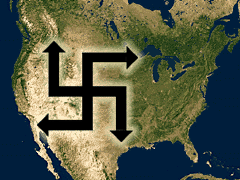
Though not to scale, this is the approximate path that Masaw, Prince of the Fourth World, gave to the chosen people to inhabit the newly
configured world. Each of the four tribes was to travel in one of the principle directions — north, south, east or west — and then turn
right, forming a swastika pattern. from there they were to continue turning right in every-increasing inward spirals until the reached their
final destination, which was indicated on special sets of stone tablets that Masaw gave to them. This swastika path is essentially the same taken
by
the sons of Japheth
after the Flood, except their "Place of Emergence" was in
the Caucasus,
on the other side of the world.
|
|
And so, the chosen people fanned out towards the four winds — north, south, east and west — from their "Place of Emergence" in the Desert Southwest. However, the exact location of this "Place of Emergence", or Sipapu, is not clear. Tradition places it in or near the Grand Canyon region, or perhaps farther north, near
Denver
which, oddly enough, appears to contain some interesting symbolism in its construction which may be relevant here. Perhaps the most likely place might be the
"Four Corners"
area where the states of Colorado, New Mexico, Arizona and Utah meet, forming a
grand cross
in the middle of the Desert Southwest, though why that area was chosen for such a configuration is also a bit of a mystery.
At any rate, in order to help them find their proper places in this new world, Masaw gave the chosen people clear directions, even writing instructions on tablets so that they would always have a reference and a remembrance to guide them.
Interestingly, their journey was not merely to the four corners of the Earth, but in a swastika pattern. Each of the four tribes was to follow their stars towards the four cardinal directions, then turn right, their paths forming a giant swastika across the Americas.
This is particularly interesting because, as we saw in our study of
Giants in the Americas, the sons of Japheth, the son of Noah also spread out across the Earth in a swastika pattern. In fact, their very symbol was the swastika, which symbolizes the four directions, or the four winds. However, they spread out across the world starting from the Caucasus range, almost on the opposite side of the world. Another interesting little factoid is that the Caucasus and Denver are on almost exactly the same longitude. One wonders if that has some sort of higher meaning, something very important that we have forgotten — or was purposely hidden from us.
Though it is not specific, the text does offer some clues as to where this giant swastika pattern was centered:
|
|

|
|
|
A Mission Indian basket decorated with swastikas. The swastika was originally a peaceful motif intended to symbolize the sun and the four winds
until Hitler misappropriated it and turned its power to diabolical ends. This symbol originated from the region of the Caucasus, indicating
that perhaps the Hopi had emigrated east from Central Asia in ancient times. Their culture and language both indicate a possible Central Asian
point of origin.
Image from
CaliforniaBaskets.com.
|
And now before Masaw turned his face from them and became invisible, he explained that every clan must make four directional migrations before they all arrived at their common, permanent home. They must go to the ends of the land — west, south, east and north — to the farthest paso (where the land meets the sea) in each direction. Only when the clans had completed these four movements, rounds, or steps of their migration could they come together again, forming the pattern of the Creator's universal plan. That is the way it was. Some clans started to the south, others to the north, retraced their routes to turn east and west, and then back again. All their routes formed a great cross whose center, Tuwanasavi [Center of the Universe], lay in what is now the Hopi country in the southwestern part of the United States, and whose arms reached to the four directional pasos. As they turned at each of these extremities they formed of this great cross a swastika, either clockwise or counter-clockwise, corresponding to the movement of the earth or of the sun. And then when their migration slowed as they reached their permanent home, they formed spirals and circles, ever growing smaller. All these patterns formed by their four migrations are the basic motifs of the symbols still found today in their pottery and basketware, on their kachina rattles and altar boards.18
So, the Hopi "Center of the Universe" was indeed in the southwestern United States, around which the four tribes circled in search of their final destination. First, however, according to the myth, all the tribes needed to travel from pole to pole, and from coast to coast, before they could walk the swastika path to their final destination. So, they first headed north, following the direction of the Spider Woman. However, instead of turning back south to find the southern pole and the two coasts, they attempted to travel through the "back door" of the world, the North Pole, to the other side of the world where Masaw had specifically forbidden them to go.
In an interesting twist to the story, the tribes were also accompanied in their migration by two "insect people" that looked like katydids or locusts. On the way, climbing up a high mountain, they were challenged by an eagle, who had been living on the mountain since
the beginning of the Fourth World. The eagle then challenged their right to live in the land which he oversees, and tested the two mahus who were leading the people by first threatening them and then shooting them with arrows. However,
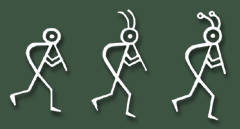
|
|
From left to right: Pictographs indicating Blue Flute, Gray Flute, and Spirit/kachina. The flute-playing, insect-like mahus who led the
clans northward are favorite characters in Native American folklore, providing warmth, music and entertainment. Image from
The Book of the Hopi,
|
|
the mahus used their magic flutes to create such sublime music that their bodies were healed of their wounds. The eagle, impressed by their
bravery and abilities, gave them permission to occupy the land, and one of his feathers which they could use to communicate with the Creator. And ever since, the Hopi have used eagle feathers and flutes to heal the sick. And to commemorate the locust mahu, when the people moved in their migrations they carved pictographs of him playing his flute all the way from Canada to the southern tip of South America.
The tribes then continued on all the way to the North Pole, which was the "back door" that Masaw had specifically forbidden them to cross. Spider Woman, however, was the one to disobey this time, and urged the people to use their powers to clear the way past the snow and ice. However, they were unable to, and Sotuknang himself appeared and admonished them for their attempt, saying that had they succeeded in melting their way through the snow and ice, the Fourth World would have been flooded and wrecked. As a punishment, Sotuknang then ordained that Spider Woman's thread would run out, and she would not die, but grow old and ugly. Moreover, her clan, the Spider clan, would from thenceforth bring forth nothing but evil.
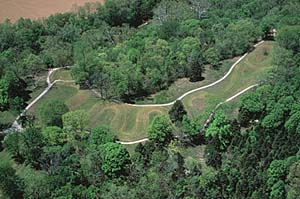
After that, the tribes, now chastened, went back south to continue their journey. They reached the Colorado River, probably in the region of the Grand Canyon, which forms a nearly impassible barrier. There, according to the myth, the Spider clan continued south to their point of origin. This means that the center of the swastika was therefore south of the Colorado River, and not Denver or even the Four Corners area, both of which are north of the Colorado. The remaining four clans, the Fire, Blue Flute, Snake and Sun Clans, then headed east as far as the Atlantic Ocean. Finding the coast, they then headed west again in obedience to the divine mandate, but tarried on the prairie for a time. There, the Snake Clan decided they wanted to leave a marker indicating that they had been there, a mark that modern Hopi believe is what is now known today as
Serpent Mound.
|
|
|
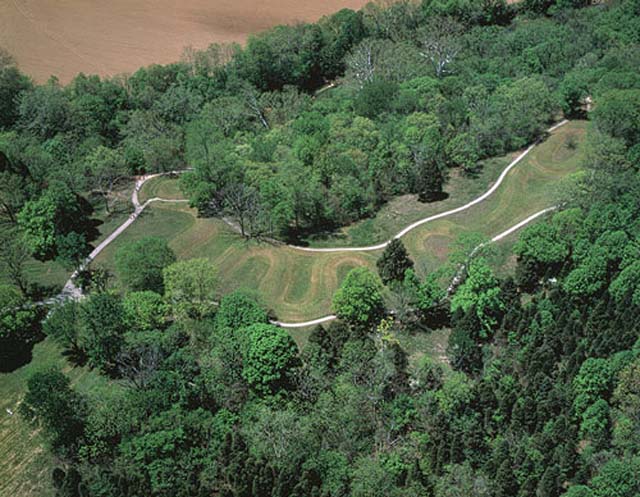
Serpent Mound,
located in
Adams County, Ohio,
near the small town of
Peebles.
The
Serpent Mound
has been the subject of a great deal of speculation as to its origins, though the Hopi believe it was simply a trail marker/magical "glyph"
intended to both mark the trail they took and act as a ward against evil in the east. Thus, its Hopi name Tokchi'i "Guardian of the
East".
|
|
Some contemporary Hopis believe that the great
Serpent Mound
near [Peebles], Ohio, may have been constructed by their ancestors. The largest serpent effigy in the world, it is an earth embankment nearly one-fourth of a mile long, twenty feet wide, and five feet high, grown over with grass that has prevented it from erosion.... Whatever its origin may be, a member of the snake clan interpreted the meaning of the Serpent Mound, according to Hopi tradition, from a photograph and drawing of it. As there was no rock in the area, the village where the people lived, the burial mounds nearby, and the Serpent Mound itself were made of plastered mud — chochmo [mud mound]. The oval mound represents the village. It was placed within the jaws of the snake to show that it was protected by the snake's power. It's extension, sticking out in front, shows that the snake has the power to draw light. The two small mounds on each side of his head represent his eyes as well as the circular markings on his body. The great length of his body indicates that he is the longest snake known to the people. He faces west because the people were traveling west when they built this mound, although he is the guardian snake of the east and would continue to protect them until they reached the wall of mountains separating east from west. His name is Tokchi'i [Guardian of the East].19
After leaving their mark, the people then passed over the Rocky Mountains, which they consider to be the "spine" of the continent, along which the twins Poqanghoya and Palongawhoya send their vibrations. Interestingly, after they passed over the mountains, they entered the domain of Katoya which, as we have seen, was the serpent who had beguiled the people of the First World and led them into sin. After reaching the west coast, they then returned east, led by their star, which then led them in a great circle over what is now the Four Corners area, stopping in the region now known as Chaco Canyon. After heading towards the four cardinal directions, they had turned right, and then right again, again and again in increasingly tight spirals until they had reached their final destination.
After having walked the great swastika, the history of each of the tribes has had its ups and downs, searching for their final destination, only a few of the original tribes actually finding it, one of those being the people generally known as the Anasazi, who would eventually become known as the Hopi.
Many of the mysteries of the Anasazi have been solved in the last 20 years. Archaeologists are fascinated by what they've been discovering about what has been the biggest puzzle of all: How did an entire civilization and culture just suddenly vanish from the face of the planet about 650 years ago?
Before serious study was given to the disappearance of the Anasazi, this central mystery had fueled a whole raft of theories, especially among New Age and UFO groups: The Anasazi had been lifted off in space ships; they had discovered portals into other dimensions of space and time; or they had mastered nodal energy centers that are scattered around the whole region. (A few hundred miles away, in Sedona, Arizona, you can help the local economy by taking a Jeep tour to conveniently located nodal points just outside of town!)
However, piece by careful piece, a more sobering explanation and history of the Anasazi has emerged over the years as follows, according to most experts:
The ancestors of the Anasazi came to Angel Canyon at least 10,000 years ago. A thousand years ago, they had become a peaceful farming society that could turn its attention to studying the stars, building observatories, creating beautiful art, and spreading their culture across the Southwest.
The Anasazi culture built its capital city at Chaco Canyon in New Mexico. Society soon became centralized as political/religious leaders asserted themselves and took control, building roads to outlying colonies and trade routes to other civilizations, in particular the Toltecs of Mexico.
Then, about 800 years ago, the economy began to collapse. The land had been overworked and when a drought set in, the leaders at Chaco Canyon became more tyrannical. The small, still-peaceful communities like those at Angel Canyon found themselves suddenly victims of the ruling classes. They moved their homes into caves high in the cliff walls and prepared to defend themselves.
To add to the woes of the Anasazi, there is evidence of bands of roaming Toltec outlaws invading their small communities, terrorizing the people, then murdering them and - one of the most shocking recent discoveries - eating them.
Rather than fighting back, the Anasazi people responded with a mass exodus. Over a period of just a few years, around 1350, they just walked away from the troubles that had beset them. They abandoned their ancestral lands and migrated south, eventually building a new culture and religion that we know as the Hopi. (The Hopi reject the name Anasazi which is a Navajo word meaning "enemy of my ancestors," and prefer to call them the Hisatsinom, or Old Ones.)20
So, the wandering tribes eventually settled down, after many thousands of years of wandering and strife, into the places we see them today. Yet, they have not forgotten their past, as so many people have, and regularly return to their Sipapu, or Place of Emergence, from where they believe they had emerged from within the
Hollow Earth
after having escaped the destructions of the three previous worlds. But where is this Sipapu? Some place at least one of the entrances into the
Hollow Earth
in the Grand Canyon. And, it is rumored, that entrance leads to an ancient "Lost City of the Dead" wherein can be found mummified giants and ancient technologies from before the Flood.

|
|
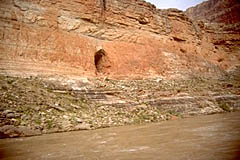
"Stanton's Cave"?. This cave is one of a warren of caves to be found throughout the Grand Canyon region. Though probably not the Sipapu of
Hopi belief,
the Place of Emergence into the first three worlds was likely a cave opening much like this one, possibly somewhere in the Grand Canyon, though
the escape from the Third World appears to have involved island hopping across the Pacific from Asia to the Desert Southwest.
The curious are warned not to explore caves without proper precautions, however. And as always, bring plenty of water. Most caves in the region
are dangerous, and this particular cave is of archaeological interest and has been sealed off with bars to prevent the public from further
contaminating it.
Image from
Lost City of the Dead in the Grand Canyon
|
|
The
"Hollow Earth"
theory is basically this: the Earth's crust is criss-crossed with a series of subterranean tunnels, some of which are natural, but many of which are man made, either completely artificial or extensions of naturally occurring tunnels. In congruence with many ancient legends, it is believed that ancient races escaped the Great Flood and other cataclysms by hiding underground, just as the ancestors of the Hopi had done. While waiting for the Earth to become habitable again, so the legends go, these peoples became very accustomed to living underground, and some of them decided to stay. The "Ant people" of the Hopi myths are likely one of these, an ancient race that has lived underground since possibly before the human race was even created.
The Hopi of course, as we have seen, have much experience with living in the Underworld, their chosen ancestors having fled underground twice to escape global cataclysms that wiped out all or nearly all life on Earth. The Hopi still visit underground kivas and leave offerings for the spirits as part of their rituals, though it is unlikely that these kivas are connected to the kind of elaborate underground tunnel systems that many have speculated exist throughout the Southwest. Nevertheless, legends and rumors still abound about lost cities and elaborate tunnel systems full of ancient treasures to be found criss-crossing the Desert Southwest:
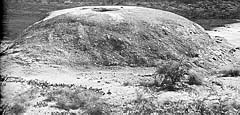
"The Hopi Indians have legends telling how and where to enter the Hollow Earth. They are said to believe that ours is the Fourth World and three others are inside the earth. Bruce A. Walton, in
|
|
|
|
This spot is thought by some to be Sipapu, entrance to the Hopi Underworld. It is a sacred place of pilgrimage for the Hopi, at the bottom of the
Canyon of the Little Colorado above its junction with the Colorado River. It is off-limits to all but the Hopi people.
Image from
Pages From Hopi History
|
|
A Guide to the Inner Earth
(1983), writes of a hole called Sipapu which is the entrance to the Hopi underground. 'It is a sacred place of pilgrimage for the Hopi, at the bottom of the Canyon of the Little Colorado above it’s junction with the Colorado River.'"21
The
Sipapu,
as we have seen, is the "Place of Emergence" through which the ancestors of the Hopi passed from earlier ages to later ages, the most recent being our present, fourth age: Tuwaqachi, the Fourth World. John Kantner explains in his excellent
Sipapu
website:
Pueblo histories and religion recognize two kinds of sipapus: The first is the original sipapu, through which First People entered the current world from the Third or Lower World (with the flute-playing Locust leading the way). Different Pueblo groups have different views as to where the original sipapu is located. Pueblos believe that the dead pass into the spirit world through the sipapu. Once upon a time, the dead would have been able to reemerge after a few days and their bodies revived, but Pueblo history says that Coyote covered the sipapu with a stone, and now only spirits, such as the kachinas, can pass through sipapu.
The second kind of sipapu is a current passage to the Third World, which can be found as small holes or even more elaborate structures in kivas. Special bodies of water or even special places in the landscape are also often considered to be sipapus. These sipapus are the means of communication with the spirits.22
These sipapu are scattered throughout the Desert Southwest, kept and revered not only by the Hopi, but also by the Navajo, Havasupai, and other Native American peoples throughout the Desert Southwest. They are not always physical openings either — some are believed to be through spiritual "power centers" to be found in lakes, rivers, and in the rocks and the trees. However, some of these sipapu are quite real. Some have even been the subject of great speculation as to whether they might lead the way to spectacular subterranean treasure troves, and ancient tombs and catacombs from the world before the Flood.

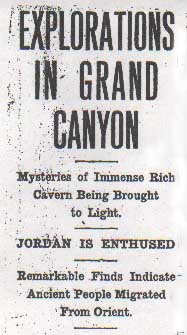
Rumors of a "Lost City of the Dead" in the Grand Canyon have been circulating for nearly a century, ever since the publication on April 5, 1909 of a mysterious article in the Phoenix Gazette of an article entitled, "Explorations in Grand Canyon: Mysteries of Immense Rich Cavern Brought to Light". This story has made its way through several books since then, most notably in popular author and world explorer David Hatcher Childress' classic,
Lost Cities of North & Central America.
The storyline basically runs like this: in 1909, two men by the name of G. E. Kinkaid and Prof. S. A. Jordan, both allegedly of the
Smithsonian Institute,
had set out on a journey to look for a mysterious underground citadel
found somewhere in the Grand Canyon,
probably near its beginnings in Marble Canyon, in or around the Navajo Indian reservation. Passing through a small cave opening, they discovered a vast, sprawling underground complex filled with amazing artifacts from a world long forgotten. Here is the story in its entirety from Jack Andrews'
Lost City of the Dead in the Grand Canyon
website:
EXPLORATIONS IN GRAND CANYON
Mysteries of Immense Rich Cavern Being Brought to Light
JORDAN IS ENTHUSED
Remarkable finds indicate ancient people migrated from Orient
The latest news of the progress of the explorations of what is now
regarded by scientists as not only the oldest archaeological
discovery in the United States, but one of the most valuable in the
world, which was mentioned some time ago in the Gazette, was brought to the city yesterday by G. E. Kinkaid, the explorer who found the great underground citadel of the Grand Canyon during a trip from Green River, Wyoming, down the Colorado, in a wooden boat, to Yuma, several months ago.
According to the story related to the Gazette by Mr. Kinkaid, the
archaeologists of the Smithsonian Institute, which is financing the
expeditions, have made discoveries which almost conclusively prove
that the race which inhabited this mysterious cavern, hewn in solid
rock by human hands, was of oriental origin, possibly from Egypt,
tracing back to Ramses. If their theories are borne out by the
translation of the tablets engraved with hieroglyphics, the mystery
of the prehistoric peoples of North America, their ancient arts, who
they were and whence they came, will be solved. Egypt and the Nile,
and Arizona and the Colorado will be linked by a historical chain
running back to ages which staggers the wildest fancy of the
fictionist.

|
|
|
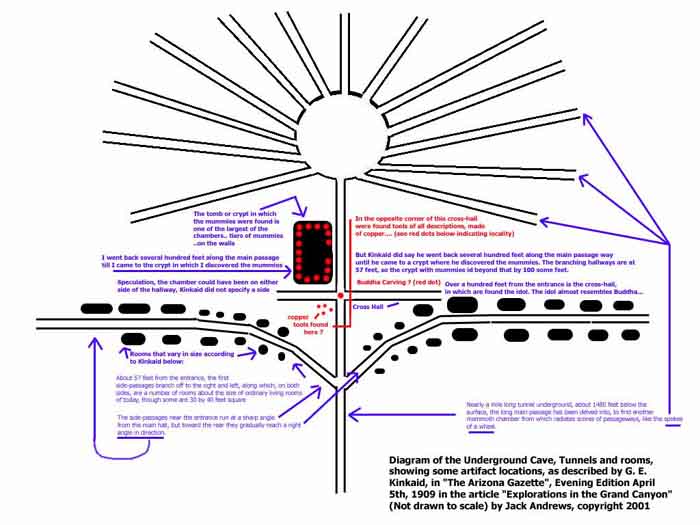
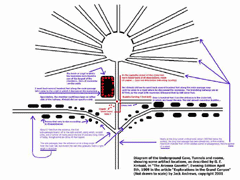
A graphical interpretation of the underground citadel described by Kinkaid. Passing through the narrow cave opening, Kinkaid followed the narrow
passage over a mile until it split into three passages, the center of which
led to a vast amphitheater with numerous passageways leading in numerous different directions to hundreds of different rooms with with ancient
artifacts of every description. Click the image to see a larger version.
Image from
Lost City of the Dead in the Grand Canyon
courtesy
Jack Andrews, © 2001
|
|
Under the direction of Prof. S. A. Jordan, the Smithsonian Institute
is now prosecuting the most thorough explorations, which will be
continued until the last link in the chain is forged. Nearly a mile
long tunnel underground, about 1480 feet below the surface, the
long main passage has been delved into, to find another mammoth
chamber from which radiates scores of passageways, like the spokes
of a wheel.
Several hundred rooms have been discovered, reached by
passageways running from the main passage, one of them
having been explored for 854 feet and another 634 feet.
The recent finds include articles which have never been
known as native to this country, and doubtless
they had their origin in the orient. War weapons, copper
instruments, sharp-edged and hard as steel, indicate the high state
of civilization reached by these strange people. So interested have
the scientists become that preparations are being made to equip the
camp for extensive studies, and the force will be increased to
thirty or forty persons.
Before going further into the cavern, better facilities for
lighting will have to be installed, for the darkness is dense and
quite impenetrable for the average flashlight.
In order to avoid being lost, wires are being strung from the
entrance to all passageways leading directly to large chambers.
How far this cavern extends no one can guess, but it is now the
belief of many that what has already been explored is merely the
"barracks", to use an American term, for the soldiers, and that
far into the under-world will be found the main communal dwellings
of the families.
The perfect ventilation of the cavern, the steady draught that
blows through, indicates that it has another outlet to the surface.

|
|
|
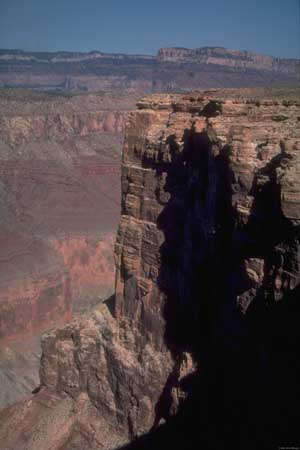
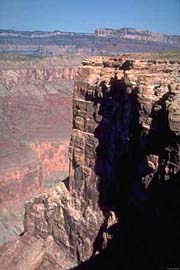
The cliff face in marble canyon purported to be the location of the cave entrance to the mysterious underground citadel. According to Kincaid,
"The entrance is 1,486 feet down the sheer canyon wall" - i.e., inaccessible to all but professional climbers. In other words, do not
attempt to find the cave yourself. Leave it to the professionals. It is believed that the river once ran much higher during the time when the
alleged cave was in use, making access relatively easy.
Image from
Lost City of the Dead in the Grand Canyon
courtesy
Jack Andrews, © 2001.
(Original Photo Courtesy Steve Wingate copyright 2000)
|
|
Mr. Kinkaid was the first white child born in Idaho and has been an
explorer and hunter all his life, thirty years having been in the
service of the Smithsonian Institute. Even briefly recounted, his
history sounds fabulous, almost grotesque.
First, I would impress that the cavern is nearly inaccessible. The
entrance is 1,486 feet down the sheer canyon wall. It is located on
government land and no visitor will be allowed there under penalty
of trespass. The scientists wish to work unmolested, without fear
of archaeological discoveries being disturbed by curio or relic
hunters.
A trip there would be fruitless, and the visitor would be sent on
his way. The story of how I found the cavern has been related, but
in a paragraph: I was journeying down the Colorado river in a boat,
alone, looking for mineral.
Some forty-two miles up the river from
the El Tovar Crystal canyon, I saw on the east wall, stains in the
sedimentary formation about 2,000 feet above the river bed. There
was no trail to this point, but I finally reached it with great
difficulty.
Above a shelf which hid it from view from the river, was the mouth
of the cave. There are steps leading from this entrance some thirty
yards to what was, at the time the cavern was inhabited, the level
of the river. When I saw the chisel marks on the wall inside the
entrance, I became interested, securing my gun and went in. During
that trip I went back several hundred feet along the main passage
till I came to the crypt in which I discovered the mummies. One of
these I stood up and photographed by flashlight. I gathered a
number of relics, which I carried down the Colorado to Yuma, from
whence I shipped them to Washington with details of the discovery.
Following this, the explorations were undertaken.

The main passageway is about 12 feet wide, narrowing to nine feet
toward the farther end. About 57 feet from the entrance, the first
side-passages branch off to the right and left, along which, on both
sides, are a number of rooms about the size of ordinary living rooms
of today, though some are 30 by 40 feet square. These are entered
by oval-shaped doors and are ventilated by round air spaces through
the walls into the passages. The walls are about three feet six
inches in thickness.
The passages are chiseled or hewn as straight as could be laid out
by an engineer. The ceilings of many of the rooms converge to a
center. The side-passages near the entrance run at a sharp angle
from the main hall, but toward the rear they gradually reach a right
angle in direction.

|
|
|
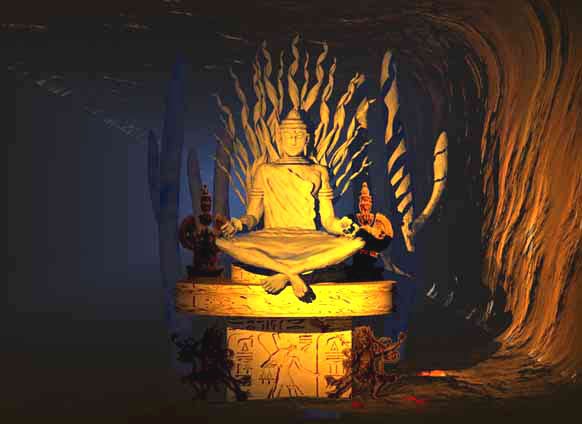
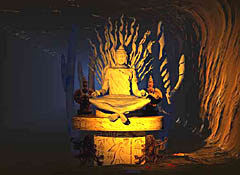
"The Shrine". Kincaid described a Buddha-like figure sitting in the lotus position, surrounded by various figurines indicating the powers of good
and evil, as well as cactus and similar appurtenences appropriate for the shrine of a southwestern deity.
Lost City of the Dead in the Grand Canyon
in depth.
Image courtesy
Jack Andrews, © 2001
|
|
Over a hundred feet from the entrance is the cross-hall, several
hundred feet long, in which are found the idol, or image, of the
people's god, sitting cross-legged, with a lotus flower or lily in
each hand. The cast of the face is oriental, and the carving shows a skillful hand, and the entire is remarkably well preserved, as is everything in this cavern. The idol almost resembles Buddha, though the scientists are
not certain as to what religious worship it represents. Taking into
consideration everything found thus far, it is possible that this
worship most resembles the ancient people of Tibet.
Surrounding this idol are smaller images, some very beautiful in
form - others crooked-necked and distorted shapes, symbolical,
probably, of good and evil. There are two large cactus with
protruding arms, one on each side of the dais on which the god
squats. All this is carved out of hard rock resembling marble. In
the opposite corner of this cross-hall were found tools of all
descriptions, made of copper. These people undoubtedly knew the
lost art of hardening this metal, which has been sought by chemists
for centuries without result. On a bench running around the
workroom was some charcoal and other material probably used in the
process. There is also slag and stuff similar to matte, showing
that these ancients smelted ores, but so far no trace of where or
how this was done has been discovered, nor the origin of the ore.
Among the other finds are vases or urns and cups of copper and
gold, made very artistic in design. The pottery work includes
enameled ware and glazed vessels. Another passageway leads to
granaries such as are found in the oriental temples. They contain
seeds of various kinds. One very large storehouse has not yet been
entered, as it is twelve feet high and can be reached only from
above. Two copper hooks extend on the edge, which indicates that
some sort of ladder was attached. These granaries are rounded, as
the materials of which they are constructed, I think, is a very hard
cement. A gray metal is also found in this cavern, which puzzles
the scientists, for its identity has not been established. It
resembles platinum. Strewn promiscuously over the floor everywhere
are what people call - cats eyes', a yellow stone of no great value.
Each one is engraved with the head of the Malay type.

On all the urns, or walls over doorways, and tablets of stone which
were found by the image are the mysterious hieroglyphics t the
key to which the Smithsonian Institute hopes yet to discover. These
writings resemble those on the rocks about this valley. The engraving
on the tables probably has something to do with the religion of the
people. Similar hieroglyphics have been found in the peninsula of
Yucatan, but these are not the same as those found in the Orient Some
believe these cave dwellers built the old canals in the Salt River Valley.
Among the pictorial writings, only two animals are found. One is of
prehistoric type.

|
|
|
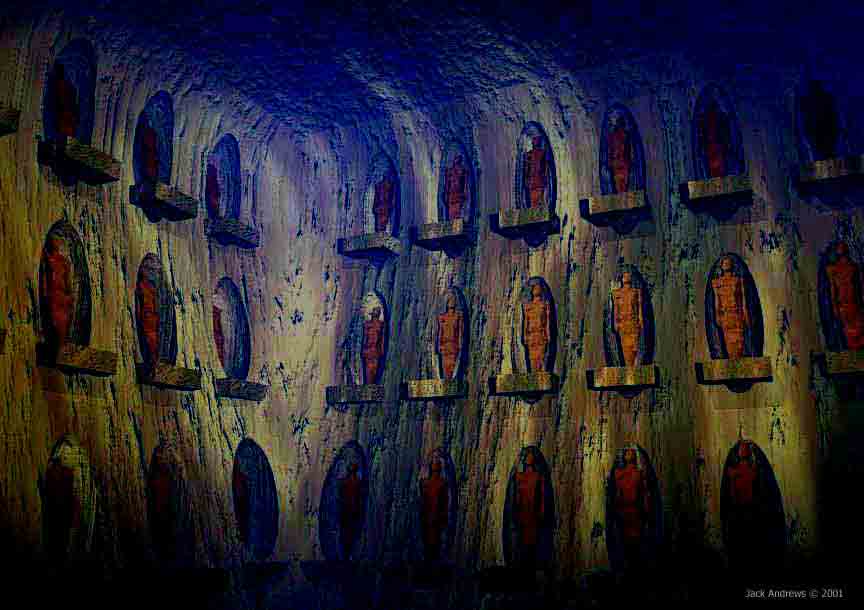
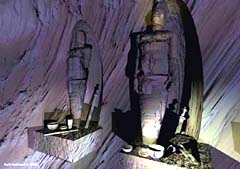
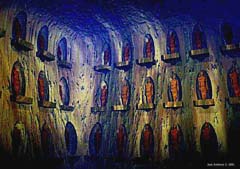
"The Crypt", wherein ancient, giant mummies were found wrapped in bark fabric and smeared with clay. These mummies, all of which were male,
were reported by Kincaid as being well-preserved and surrounded by copper implements that they had used during their lives.
Image from
Lost City of the Dead in the Grand Canyon
courtesy
Jack Andrews, © 2001
|
|
The tomb or crypt in which the mummies were found is one of the
largest of the chambers, the walls slanting back at an angle of
about 35 degrees. On these are tiers of mummies, each one occupying
a separate hewn shelf. At the head of each is a small bench, on
which is found copper cups and pieces of broken swords. Some of the
mummies are covered with clay, and all are wrapped in a dark fabric.
The urns or cups on the lower tiers are crude, while as the higher
shelves are reached, the urns are finer in design, showing a later
stage of civilization. It is worthy of note that all the mummies
examined so far have proved to be male, no children or females being buried here.
This leads to the belief that this exterior section
was the warrior' barracks.
Among the discoveries no bones of animals have been found, no
skins, no clothing, no bedding. Many of the rooms are bare but for
water vessels. One room, about 40 by 700 feet, was probably the
main dining hall, for cooking utensils are found here. What these
people lived on is a problem, though it is presumed that they came
south in the winter and farmed in the valleys, going back north in
the summer.
Upwards of 50,000 people could have lived in the caverns
comfortably. One theory is that the present Indian tribes found in
Arizona are descendants of the serfs or slaves of the people which
inhabited the cave. Undoubtedly a good many thousands of years
before the Christian era, a people lived here which reached a high
stage of civilization. The chronology of human history is full of
gaps. Professor Jordan is much enthused over the discoveries and
believes that the find will prove of incalculable value in
archaeological work.
One thing I have not spoken of, may be of interest. There is one
chamber of the passageway to which is not ventilated, and when we
approached it a deadly, snaky smell struck us. Our light would not
penetrate the gloom, and until stronger ones are available we will
not know what the chamber contains. Some say snakes, but other
boo-hoo this idea and think it may contain a deadly gas or chemicals
used by the ancients. No sounds are heard, but it smells snaky just
the same. The whole underground installation gives one of shaky
nerves the creeps. The gloom is like a weight on one's shoulders,
and our flashlights and candles only make the darkness blacker.
Imagination can revel in conjectures and ungodly daydreams back
through the ages that have elapsed till the mind reels dizzily in
space.

|
|
|
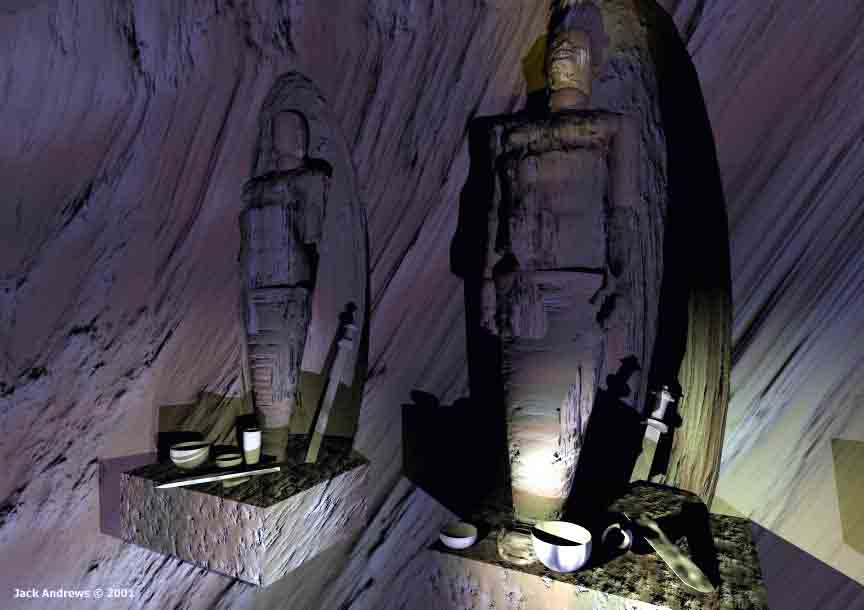
"The Barracks" - a wider view of the mummies of the male warriors that had been found in a large crypt just off the central area in the
underground citadel. These males may have formed a giant, warrior elite, similar to that found in central Asia, as we discovered in the
Giants in the Earth
series.
Image from
Lost City of the Dead in the Grand Canyon
courtesy
Jack Andrews, © 2001
|
|
In connection with this story, it is notable that among the Hopi
Indians the tradition is told that their ancestors once lived in an
underworld in the Grand Canyon till dissension arose between the
good and the bad, the people of one heart and the people of two
hearts. Machetto, who was their chief, counseled them to leave the
underworld, but there was no way out. The chief then caused a tree
to grow up and pierce the roof of the underworld, and then the
people of one heart climbed out. They tarried by Paisisvai (Red
River), which is the Colorado, and grew grain and corn.
They sent out a message to the Temple of the Sun, asking the
blessing of peace, good will and rain for people of one heart. That
messenger never returned, but today at the Hopi villages at sundown
can be seen the old men of the tribe out on the housetops gazing
toward the sun, looking for the messenger. When he returns, their
lands and ancient dwelling place will be restored to them. That is
the tradition.
Among the engravings of animals in the cave is seen the image of a
heart over the spot where it is located. The legend was learned by
W.E. Rollins, the artist, during a year spent with the Hopi Indians.
There are two theories of the origin of the Egyptians. One is that
they came from Asia another that the racial cradle was in the upper
Nile region. Heeren, an Egyptologist, believed in the Indian origin
of the Egyptians. The discoveries in the Grand Canyon may throw
further light on human evolution and prehistoric ages.23
Though the story of "The Lost City of the Dead" is most likely apocryphal, there is no doubt — as we have seen — that it does indeed fit conceptually into the ancient history of America's Desert Southwest. A vast, underground city intended to house thousands of people would indeed fit the requirements for the type of massive facilities that would have been necessary for the ancient ancestors of the Hopi to survive through the cataclyms that had destroyed the previous three worlds. Moreover, though it is not specifically stated, it may be that the mummies that were found in the crypt were indeed gigantic in stature, which would fit in well with the numerous reports of giant mummies, skeletons, and other artifacts of
Americas ancient giant past.
It is interesting to note the Kincaid story ends with the recitation of an old Hopi myth — apparently a variation of the myth elucidated in
The Book of the Hopi
— wherein the Hopi had originated from an underground cavern system in the Grand Canyon, instead of having migrated from the west. One could speculate that perhaps the the Hopi, "the people of the one heart", had been specially bred as a slave race by and for "the people of the two hearts", and later rebelled and escaped to become the Native American peoples we know today. And what exactly was meant by "people of the one heart" and "people of the two hearts"? The people of the one heart are people who are honest, whereas the people of the two hearts are people who say one thing, but are thinking another — i.e., liars — those who speak with "forked tongue".
Whereas the ancient race of the two hearts apparently has long since died out, the people of the one heart remain even today — proving that those who live out of balance with nature and with each other eventually die out, whereas those who strive to maintain balance with nature and each other, though it may mean making personal sacrifices, survive for the long term. Modern man could take a lesson from the Hopi, to study the lifeways of this ancient people, and perhaps see why their simple society remains intact, while our modern society, though technologically advanced, is out of balance and rapidly falling apart.


|
|
|
A still image from the classic moon sequence in the critically acclaimed film,
Koyaanisqatsi,
a semi-documentary, stop-motion photographic essay of how modern society is out of balance with nature and is in danger of self-destruction as a
result.
Image from
Koyaanisqatsi - The Official Site.
|
|
Koyaanisqatsi, or "life out of balance", is the term that the Hopi elders use to describe our society today. They in their wisdom, from the perspective of thousands of years of unchanged traditions, see that though we have become wealthy and technologically advanced, living in luxury and seeming invincibility, we have achieved these things at the expense of our own souls. As it was in Tokpela, the First World, so we now are increasingly engaging in larger and larger wars, using violence as a means to uncertain ends. As it was in the Topka, the Second World, we are overly concerned with acquiring more and more goods and luxury items. As it was in Kuskurza, the Third World, we are overly concerned with sex, using sex as a means of recreation rather than procreation.
It appears that we of Tuwaqachi, the Fourth World, are guilty of all of the sins of the first three worlds combined. Sex, violence and greed have all characterized the civilizations of this fourth age, perhaps more than in any previous age, and now more than ever before. Out of balance with nature, with our fellow man, and even with our own selves, we have fallen away from the Creator's plan.
The Hopi prophesies speak of a time when our technological obsessions will be a sign that the end is indeed near:
"If we dig precious things from the land, we will invite disaster."
"Near the Day of Purification, there will be cobwebs spun back and forth in the sky."
"A container of ashes might one day be thrown from the sky which could burn the land and boil the oceans."25
If we continue to invite disaster through our failure to follow the Creator's plan by abandoning our self-destructive lifestyle and returning to the ways that the Creator has ordained for mankind since the beginning of time,
according to the Hopi myths Masaw, Prince of the Fourth World, will rise up to judge us: "But if you go back to evil ways again I will take over the Earth from you, for I am its caretaker, guardian and protector."24
From the Desert Southwest
he will arise, even from the gates of hell, leaving
the ancient, twisted cross
in his wake to retake the world that we had failed to balance, with weapons of war that the world has not seen since the end of the Third Age. But he will too will fail to restore the balance through violence, and he will be destroyed without hand when the
day star
arises in our hearts. 
The Grand Canyon Part I: Postcards from the Edge
NEW!
Grand Canyon Discussion Board
(Requires Registration)
The Hopi Cosmology
|
The Place of Emergence
|
The Hollow Earth
The Lost City of the Dead
|
Koyaanisqatsi
|
Grand Canyon Links
|
Grand Canyon Books
Grand Canyon Audio
|
Grand Canyon Video
Editorial
|
Press Releases
|
Book Reviews
|
Fragments
NEW! Artifacts: Coral Castle
Grand Canyon II
|
Giants IV
|
Osiria IV
Register
for our Hall of Records Newsletter!
Questions? Comments? Suggestions? Advertising? Press Releases?
Contact us!

1
Robert Wallace,
The Grand Canyon (The American Wilderness/Time-Life Books)
(New York: Little Brown & Company, 1972), 96.
2
Frank Waters, Oswald White Bear Fredericks,
The Book of the Hopi
(New York: Penguin Books, 1963), 3-4. The term "universes" here might be better translated as "planets", to correspond with the nine known planets in our solar system. The allocation of one of these planets to Taiowa is intriguing, particularly since Pluto is now known to be not a planet, but an escaped satellite of Neptune.
3
Waters, Fredericks,
The Book of the Hopi, 4-5. Compare this description of the creation and duties of Spider Woman to "Lady Wisdom" described in Proverbs 8:
"The LORD brought me forth as the first of his works,
before his deeds of old;
I was appointed from eternity,
from the beginning, before the world began.
When there were no oceans, I was given birth,
when there were no springs abounding with water;
before the mountains were settled in place,
before the hills, I was given birth,
before he made the earth or its fields
or any of the dust of the world.
I was there when he set the heavens in place,
when he marked out the horizon on the face of the deep,
when he established the clouds above
and fixed securely the fountains of the deep,
when he gave the sea its boundary
so the waters would not overstep his command,
and when he marked out the foundations of the earth.
Then I was the craftsman at his side.
I was filled with delight day after day,
rejoicing always in his presence,
rejoicing in his whole world
and delighting in mankind." ( Proverbs 8:22-31, emphasis mine). Apparently the Hebrew conception of the Creation also included a feminine spirit whom God also had created in order to delegate the task of creating life on Earth, including mankind. The feminine aspect is likely symbolic, as spirits do not have gender. Note also the very close similarity to the Hopi version of the creation the universe by Sotuknang.
4
Waters, Fredericks,
The Book of the Hopi, 5.
5
Mystica.org:
"Nintu" (Mystica.org: http://www.themystica.org). One version of the creation of mankind, the Babylonian Creation Epic, has Marduk, the newly-crowned king of the gods, slaying the god Kingu and using his blood to create mankind.
6
Waters, Fredericks,
The Book of the Hopi, 7.
7
Waters, Fredericks,
The Book of the Hopi, 11-12.
8
Waters, Fredericks,
The Book of the Hopi, 12-13.
9
Waters, Fredericks,
The Book of the Hopi, 13.
10
Waters, Fredericks,
The Book of the Hopi, 13-14.
11
Waters, Fredericks,
The Book of the Hopi, 14-15. Note the close similarity to Revelation 6:
"I watched as he opened the sixth seal. There was a great earthquake. The sun turned black like sackcloth made of goat hair, the whole moon turned blood red,
and the stars in the sky fell to earth, as late figs drop from a fig tree when shaken by a strong wind.
The sky receded like a scroll, rolling up, and every mountain and island was removed from its place.
Then the kings of the earth, the princes, the generals, the rich, the mighty, and every slave and every free man hid in caves and among the rocks of the mountains.
They called to the mountains and the rocks, 'Fall on us and hide us from the face of him who sits on the throne and from the wrath of the Lamb!
For the great day of their wrath has come, and who can stand?'" (Rev. 6:12-17). Though the "ant people" aren't explicitly mentioned, mankind will seek to go underground once again to save themselves in the End Times. However, some feel that the Hopi reference to the "ant people" refers to the so-called "grey aliens", typically referred to as
"the greys"
an insectlike alien race that some believe live underground, and have done so since the beginning. Others go so far as to claim that the military has been working hand-in-hand with the greys and other "alien races" for decades to prepare for an "invasion" from outer space, digging massive amounts of tunnels in preparation. For more on this subject, look
here
or search
here.
12
Waters, Fredericks,
The Book of the Hopi, 15-16.
13
Waters, Fredericks,
The Book of the Hopi, 16-17.
14
Waters, Fredericks,
The Book of the Hopi, 17-18.
15
Waters, Fredericks,
The Book of the Hopi, 20. Traveling from the west to arrive in the Desert Southwest, the ancestors of the Hopi must therefore have been island-hopping across the Pacific Ocean. Other ancient traditions tell of a mysterious continent known as Lemuria that had once dominated the Pacific before it had been destroyed by the gods for its wickedness. Could this perhaps have been a memory of some ancient, cataclysmic event which these two traditions held in common?
16
Waters, Fredericks,
The Book of the Hopi, 22.
17
For more information on the origin and role of fallen angels on the Earth, read
The Legend of Atlantis Part II: The Antediluvian World,
The Legend of Atlantis Part III: Edgar Cayce's Atlantis, and
Giants in the Earth Part I: Giants of the Ancient Near East.
The implication from this passage is that Masaw will be given power over the Earth and the authority to punish mankind for their sins against the Creator at the end of this Fourth Age. Masaw is likely cognate to Azazel, the fallen angel described in the Book of Enoch, and may also be the power behind the Antichrist described in the books of Daniel and Revelation. This "Antichrist" will be given authority only because of the greatness of the sins that mankind will commit against the Creator and His Creation at the end of the Fourth Age, and he will use violence to make the people fulfill God's laws when they refuse to do it willingly. But he will go too far and incur God's judgment against himself as well as those on Earth who disobeyed the laws, and will be destroyed by Sotuknang himself without hand, after the chosen are removed from the Earth.
18
Waters, Fredericks,
The Book of the Hopi, 35.
19
Waters, Fredericks,
The Book of the Hopi, 40-41.
20
Mary Sutherland,
"Hopi Legend of Shambhala and the Sacred Mountain Mount Meru" (Living in the Light: http://www.livinginthelightms.com).
21
Xenophilia,
"The Hollow Earth - Strange Beliefs: The Pole Holes & the Underworld" (Xenophilia: http://www.xenophilia.com).
22
John Kantner,
"What is a "Sipapu"?" (Sipapu: The Anasazi Emergence into the Cyber World: http://sipapu.gsu.edu).
23
Jack Andrews,
"Lost City of the Dead in the Grand Canyon" (Lost Civilizations and Hidden Mysteries: http://www.gci-net.com/users/v/vrartist/).
24
Waters, Fredericks,
The Book of the Hopi, 22.
25
John Kantner,
"Koyaanisqatsi: Definitions" (Koyaanisqatsi - The Official Site: http://www.koyaanisqatsi.org).

Kayak Place: Nankoweap, The Little Colorado, Cardenas (Mile 72)
Desert USA: Grand Canyon National Park
Navajo Mythology: Spider Woman
"Spider Woman" Stories of the World
Crystal Links: Spider Woman
Anansi WebSide Stories
Desert USA: The Anasazi: The People of the Mountains, Mesas and Grasslands
Desert USA: The Anasazi Part 2: Community Planners, Architects and Builders
Sipapu: The Anasazi Emergence into the Cyber World
BUFO Radio: Underground Tunnel Systems in the Superstition Mountains
The Hollow Earth Insider: Secret Underground Tunnels Past & Present: Part II A Closer Look
Hollow Earth Society
About.com: The Hollow Earth
Hollow Earth Videos
Lost City of the Dead in the Grand Canyon
Cyber Space Orbit: Ancient Egyptian Treasures in the Grand Canyon
Keelynet: Archaeological Coverups
Unknown History: Archaeological Coverups
Lost Civilization and Hidden Mysteries: Lost City of the Dead in the Grand Canyon
-
Introduction
-
How I Came into Contact with This Story
-
Explorations in Grand Canyon
-
The Importance of the find in 1909
-
G. E. Kincaid Reaches Yuma
-
The Story Related to the Arizona Gazette in 1909 was NOT Routine Sensationalism
-
Was the Cave a Buddhist Temple?
-
Prince Izon
-
The Search for Kinnaman's Entrance
-
Official Smithsonian Replies to Inquiries
-
Diagram showing some of the Underground "Cave" Tunnels and Rooms
-
Copper at the Cave Site
-
Conspiracy Coverup?
-
Racism in the 1909 article
-
1486 Feet and Isis Temple
-
Was the Cave "Located on Government Land" in 1909?
-
Small Skiffs and Rough Rapids
-
The Location of Kincaid's "Cave" Revealed
-
Water at 2000 feet?
-
History of KODAK Cameras
-
Kincaid Traveled through Yuma and Passed through Laguna Dam
-
The Shrine
-
The Ancient People of the Cave Knew How to Harden Copper
-
Strewn All Over the Floor Were Hardened "Cat's Eye" Stones
-
Are These Images the Actual Hieroglyphics in the 1909 Cave?
-
Why Did Someone Delete References in the Internet Version of the 1909 Story?
-
"Canals" Near the Site?
-
The Crypt
-
The Crypt (Closeup View)
-
Is the 1909 "cave" even in Grand Canyon National Park?
-
1909 Grand Canyon Cave Location REVEALED!!
-
Kincaid the Prospector and more... on copper at the Grand Canyon site
Grand Canyon Explorer
Xpeditions Magazine: Egyptian Artifacts in the Grand Canyon
Native American Fine Art: About the Hopi Indians
CSAC's Ethnographics Gallery: Society-HOPI
The Official Hopi Cultural Preservation Office Home Page
Carnegie Museums: The Hopi of the Southwest
Indiana University: Hopi Indians
Sacred Texts: The Traditions of the Hopi
University of Arizona Press: Pages From Hopi History (Excerpt)
Living in the Light: The Traditions of the Hopi
Xenophilia: The Hollow Earth
CrystaLinks: Hopi Civilization
Koyaanisqatsi - Official Site
CrystaLinks: Hopi Blue Star Prophecy
CrystaLinks: Hopi Myths
CrystaLinks: Spider Woman Legends
Sacred Land Film Project: The Hopi and the Colorado Plateau
Morgana's Observatory: Hopi Prophecies
ViewZone: The Hopi Prophecy Rock
The Big Trunk Site: Native American Indian Prophecies
Native American Light: Tribal Wisdom, Prophecy, Resources
Hopi Cultural Center: Museum, Restaurant & Motel
Sacred Places Travel: Adult Pilgrimage to the Sacred Land of the Navajo and Hopi
In New Mexico and Arizona
Sacred Places Travel: Sharing a Spiritual Journey
Joseph Holmes Gallery: The Colorado River at Nankoweap
Grand Canyon Information
Grand Canyon Trip Planner Package
The Online Guide: Grand Canyon National Park
GrandCanyon.com
National Park Service: Grand Canyon
National Park Service: Welcome to Grand Canyon National Park
National Park Service: South Rim Transit
National Park Service: Museum Collection Grand Canyon National Park
National Park Service: Grand Canyon Photos
Grand Canyon Webcam
World Heritage Sites: Grand Canyon National Park
TheCanyon.com
GrandCanyonHiker.com
Grand Canyon National Park Hiking Page
Grand Canyon Treks!
Grand Canyon IMAX Theater
Grand Canyon Railway
Phantom Ranch & The Colorado River
Grand Canyon Explorer: El Tovar Hotel
Grand Canyon Explorer
Desert USA: Grand Canyon National Park
The Grand Canyon Tour Company
Grand Canyon Private Boaters Association
Western River Expeditions
Heli USA: Grand Canyon flights
American Memory: Maps of Grand Canyon National Park
Sinbad Tours: Navajo and Hopi Land


 The Grand Canyon (The American Wilderness/Time-Life Books)
Robert Wallace
Rating:
Part of Time-Life's classic "American Wilderness" series, Grand Canyon provides a very thorough and detailed overview of all aspects of the canyon. From it's geologic origins and its role in Native American life and culture to its current status as a national monument and favorite tourist destination, Grand Canyon is an excellent starting point and general reference tool for those who wish to study the Grand Canyon in detail. (Review by Mysterious World)
Click
here
to buy this book.
 Book of the Hopi
Frank Waters, Oswald White Bear Fredericks
Rating:
In this strange and wonderful book, thirty elders of the ancient Hopi tribe of Northern Arizona — a people who regard themselves as the first inhabitants of America — freely reveal the Hopi worldview for the first time in written form. The Hopi kept this view a secret for countless centuries, and anthropologists have long struggled to understand it. Now they record their myths and legends, and the meaning of their religious rituals and ceremonies, as a gift to future generations. Here is a reassertion of a rhythm of life we have disastrously tried to ignore and insticts we have tragically repressed; and a reminder that we must attune ourselves to the need for inner change if we are to avert a cataclysmic rupture between our minds and our hearts. (From the back cover)
Click
here
to buy this book.
 Lost Cities of North & Central America (The Lost City Series)
David Hatcher Childress
Rating:
One of the popular "Lost Cities" series, this book is a must-have guidebook for mysterious places in North and Central America. I enjoy Childress' books mainly because he comes across as very honest, although he engages in too much speculation to be taken at face value. Overall I find his books a very engaging read, and the speculative aspect, though often unscientific, is very entertaining. Moreover, the amazing amount of study and travel he has done brings a certain amount of credibility to his work. I highly recommend the "Lost Cities" series of books both for their refreshingly informal approach and for their "infotainment" value. These books are definitely not for the timid, and certainly not for the closed-minded. (Review by Mysterious World)
Click
here
to buy this book.
A Guide to the Inner Earth
Bruce A. Walton
The classic study of the Hollow Earth theory. Recommended only for those with an open mind, and interested in learning about some of the more esoteric myths and legends of Earth's ancient history (Review by Mysterious World)
Click
here
to buy this book.
 The Sierra Club Guides to the National Parks of the Desert Southwest
The Sierra Club
Rating:
Newly revised and updated, this guide offers practical travel information to the desert Southwest's national parks. Outstanding color photographs, maps, park facility charts, geological and historical information about each park, and identification of animals and plants commonly found within the parks. Our month-long tour of the Desert Southwest was greatly enhanced by this book. (Review by Amazon.com)
Click
here
to buy this book.
 The Grand Canyon
Letitia Burns O'Connor
Rating:
Stunning color photos are the main feature of this large-format book. Tom Bean, Michael Collier, David Muench, and Greg Probst are among the nine notable outdoor photographers whose works are included. The large format is successful in capturing some essence of the grandeur and scope of this unique geological area. The limited text by O'Connor and Zurofsky focuses on history, exploration, and tourism. Photos range from wide-angle landscapes shot at varying times of day and seasons of the year, to closeups of geological features such as erosion, slickrock, and fossils, to "portraits" of indigenous wildlife. Limited bibliographies accompany the text. This book is recommended for comprehensive collections on the Southwest. (Review by Amazon.com)
Click
here
to buy this book.
 Over the Edge: Death in Grand Canyon
Michael P. Ghiglieri, Thomas M. Myers
Rating:
Gripping accounts of all known fatal mishaps in the most famous of the World's Seven Natural Wonders.
Two veterans of decades of adventuring in Grand Canyon chronicle the first complete and comprehensive history of Canyon misadventures. These episodes span the entire era of visitation from the time of the first river exploration by John Wesley Powell and his crew of 1869 to that of tourists falling off its rims in Y2K.
These accounts of the 550 people who have met untimely deaths in the Canyon set a new high water mark for offering the most astounding array of adventures, misadventures, and life saving lessons published between any two covers. Over the Edge promises to be the most intense yet informative book on Grand Canyon ever written.
(From the book description)
Click
here
to buy this book.
 First Through Grand Canyon: The Secret Journals & Letters of the 1869 Crew Who Explored the Green & Colorado Rivers
Michael P. Ghiglieri
In May of 1869, eleven men embarked on a journey of exploration and discovery. 98 days later six of them arrived 1000 miles away after navigating the Green and Colorado Rivers to the end of Grand Canyon. The journals and writings of the expedition leader, John Wesley Powell have been extensively published but here, for the first time, are the newly transcribed, unabridged journals and letters of some of the other members of the group. Author Ghiglieri has used his extensive river running experience to introduce the whole group and their exploits of courage and endurance.
(From the book description)
Click
here
to buy this book.
 Canyons of the Colorado
Joseph Holmes, John Wesley Powell, David Ross Brower
Rating:
In Canyons of the Colorado, the exquisite talent of photographer Joseph Holmes is matched with one of the most thrilling adventures ever chronicled: John Wesley Powell's epic exploration of the Colorado River. Sixty-two stunning images comprise a vivid tribute to the compelling landscape that has enchanted and inspired Holmes for over twenty years — from grand vistas and exquisitely colorful canyon walls to the sublime details of the river's ebb and flow. Holmes' original essays highlight his own adventures in pursuit of his own comparable images and reflect on the magic and serenity of the Colorado basin. (From the book description)
Click
here
to buy this book.
 Grand Canyon Country
National Geographic
From near and far they come, nearly five million each year, to see the Grand Canyon, long cherished as one of the nation's treasures. Grand Canyon Country explores more than the spectacular 277-mile-long gash in Arizona's red-rock country. Author Seymour L. Fishbein takes you to the remote forests of the Kaibab Plateau, the lonely reaches of the Arizona strip, and the multihued landscapes of the Painted Desert. Fishbein probes the intriguing history of canyon country, meets its people, and talks with those who ponder environmental issues and see threats to this magnificent region. The book — like the canyon itself — is something to treasure. (From the book description)
Click
here
to buy this book.
 Grand Canyon: A Different View
Tom Vail (Compiler)
This gift book is also a creationist's delight. Filled with stunning photos of the Grand Canyon from the rim to the waterfalls and river in the bottom. This beautiful book describes the canyon in terms of only a few thousand years old, instead of the evolutionary-biased millions of years. Includes essays from 20 top creationists such as Ken Ham and Henry Morris. (From the book description)
Click
here
to buy this book.

 Closer to Far Away
Douglas Spotted Eagle
Rating:
This moving offering from Native American artist Douglas Spotted Eagle combines a jazzy, light pop influence with well-choreographed Native American vocals and authentic Native American instrumentation. Highly listenable and alternately mysterious and uplifting. Douglas Spotted Eagle's Closer to Far Away is an excellent addition to any world music collection, or for anyone who enjoys some very smooth, enjoyable ambient music.
(Review by Mysterious World)
Click
here
to buy this CD.
 Koyaanisqatsi: Life Out Of Balance
Philip Glass
Rating:
Fifteen years after its initial release, Philip Glass's score to Godfrey Reggio's film Koyaanisqatsi is still as timeless as it was
meant to be. Glass's epic score, virtually the only sound in this non-narrative movie, accompanied an exhilarating, wordless meditation
of images ranging from expansive, slow-motion landscapes to whirling-dervish city scenes shot using time-lapse techniques. Glass's music
was a perfect match. The opening chant is still unlike anything Glass has composed, a Tibetan monk operatic growl that set up the
foreboding sense of loss the film engenders. Most of the score, however, casts Glass's minimalist themes in orchestral expanses.
Bass strings troll the bottom while flutes draw circles in the air. On "The Grid," manic keyboards drive into the night, pounding
out the cyclical refrains that are a Glass trademark. When Koyaanisqatsi came out, it seemed opulent with its orchestral forces,
but always at the center were the keyboards, reeds, and voice that are Glass's characteristic sound. Koyaanisqatsi means
"life out of balance," but Glass's remarkably austere score remains perfectly poised. This newly re-recorded edition adds nearly 30
minutes to the previous CD release with two previously unissued tracks and extended versions of "The Grid" and "Prophecies," the two
signpost works of the film. (Review by Amazon.com about the
1998 re-recording
of this album)
Click
here
to buy this CD, or
here
to buy the 1998 re-recording.
 Grofé: Grand Canyon Suite/Gershwin: Porgy and Bess —
A Symphonic Picture
Ferde Grofe, George Gershwin
Rating:
This CD combines two of the twentieth century's greatest composers: the oft-overlooked Ferde Grofe, and the more popular George Gershwin. Grofe shines most brightly on this album, however, his stirring composition of the beauty and danger of the Grand Canyon boldly painted in this masterpiece of twentieth century classical music: The Grand Canyon Suite. From the beginning to the end it is clear that Grofe not only visited the canyon, but was profoundly moved by it, as one can clearly hear in this gem of a recording done by the Detroit Symphony Orchestra under Antal Dorati.
(Review by Mysterious World)
Click
here
to buy this CD.
 Dances With Wolves: Original Motion Picture Soundtrack
John Barry
Rating:
John Barry's Academy Award-winning score for actor/director Kevin Costner's nouveau western, Dances with Wolves, is nothing short of a modern classic by a film scoring master. Utilizing Wagnerian structure, Barry's three main themes recur in magisterial symphonic form. The memorable "John Dunbar" theme alone has become an almost subconscious part of modern life, utilized as Muzak and underscore for public events great and small. Barry's skills as an arranger color his themes in subtly shifting orchestral hues, giving even the most repeated melodic passages new emotional weight. Barry's rich music is living proof that the art of orchestral film scoring is still alive and surprisingly vital in the '90s.
(Review by Amazon.com)
Click
here
to buy this CD.

 Koyaanisqatsi / Powaqqatsi (2 Pack)
Koyaanisqatsi
First-time filmmaker Godfrey Reggio's experimental documentary from 1983--shot mostly in the desert Southwest and New York City on a tiny budget with no script, then attracting the support of Francis Ford Coppola and George Lucas and enlisting the indispensable musical contribution of Philip Glass--delighted college students on the midnight circuit and fans of minimalism for many years. Meanwhile, its techniques, merging cinematographer Ron Fricke's time-lapse shots (alternately peripatetic and hyperspeed) with Glass's reiterative music (from the meditative to the orgiastic)--as well as its ecology-minded imagery--crept into the consciousness of popular culture. The influence of Koyaanisqatsi, or "life out of balance," has by now become unmistakable in television advertisements, music videos, and, of course, similar movies such as Fricke's own Chronos and Craig McCourry's Apogee. Reggio shot a sequel, Powaqqatsi (1988), and completed the trilogy with Naqoyqatsi (2002). Koyaanisqatsi provides the uninitiated the chance to see where it all started--along with an intense audiovisual rush.
Powaqqatsi
Powaqqatsi (1988), or "life in transformation," is the second part of a trilogy of experimental documentaries whose titles derive from Hopi compound nouns. The now legendary Koyaanisqatsi (1983), or "life out of balance," was the first. Naqoyqatsi (2002), or "life in war," was the third. Powaqqatsi finds director Godfrey Reggio somewhat more directly polemical than before, and his major collaborator, the composer Philip Glass, stretching to embrace world music. Reggio reuses techniques familiar from the previous film (slow motion, time-lapse, superposition) to dramatize the effects of the so-called First World on the Third: displacement, pollution, alienation. But he spends as much time beautifully depicting what various cultures have lost--cooperative living, a sense of joy in labor, and religious values--as he does confronting viewers with trains, airliners, coal cars, and loneliness. What had been a more or less peaceful, slow-moving, spiritually fulfilling rural existence for these "silent" people (all we hear is music and sound effects) becomes a crowded, suffocating, accelerating industrial urban hell, from Peru to Pakistan. Reggio frames Powaqqatsi with a telling image: the Serra Pelada gold mines, where thousands of men, their clothes and skin imbued with the earth they're moving, carry wet bags up steep slopes in a Sisyphean effort to provide wealth for their employers. While Glass juxtaposes his strangely joyful music, which includes the voices of South American children, a number of these men carry one of their exhausted comrades out of the pit, his head back and arms outstretched--one more sacrifice to Caesar. Nevertheless, Reggio, a former member of the Christian Brothers, seems to maintain hope for renewal.
(Review by Amazon.com)
Click
here
to buy this DVD.
 In the Light of Reverence (2001)
Across the USA, Native Americans are struggling to protect their sacred places. Religious freedom, so valued in America, is not guaranteed to those who practice land-based religion. Every year, more sacred sights -- the land-based equivalent of the world's great cathedrals -- are being destroyed. Stripmining and development cause much of the destruction. But rock climbers, tourists, and New Age religious practitioners are part of the problem, too. The biggest problem is ignorance. In the Light of Reverence tells the story of three indigenous communities and the lands they struggle to protect: the Lakota of the Great Plains, the Hope of the Four Corners area and the Wintu of northern California. (Review by Amazon.com)
Click
here
to buy this DVD.
 Grand Canyon National Park (1993)
This DVD is by far the best depiction of the Canyon's beauty that I've ever seen. However, you have to experience the Grand Canyon yourself to put all this beauty seen on the DVD in perspective. (Review by Amazon.com)
Click
here
to buy this DVD.
 National Lampoon's Vacation (20th Anniversary Special Edition)
Rating:
The Griswolds have planned all year for a great summer vacation. From their suburban Chicago home, across America, to the wonders of Wally World fun park in California, every step of the way has been carefully plotted. Except a few hundred hysterical exceptions. National Lampoon's Vacation is a sublimely goofy comedy, thanks largely to Chevy Chase in his signature role of Clark Griswold. The inept but sincere Clark takes misfortune in stride. So what if they lose all their money when their new car gets wrecked. And it's not too bad when Cousin Eddie (Randy Quaid) deposits sour Aunt Edna (Imogene Coca) in their back seat for a lift to Phoenix. But what really keeps Clark's eyes on the road is a flirtation with a mysterious blonde (Christie Brinkley) in a red Ferrari. For those along on the ride, National Lampoon's Vacation, called "fast, funny satire" by The New York Times' Janet Maslin, is a jolly jaunt.
(From the DVD description)
Click
here
to buy this CD.
Editorial
|
Press Releases
|
Book Reviews
|
Fragments
NEW! Artifacts: Coral Castle
Grand Canyon II
|
Giants IV
|
Osiria IV
Register
for our Hall of Records Newsletter!
Questions? Comments? Suggestions? Advertising? Press Releases?
Contact us!
|